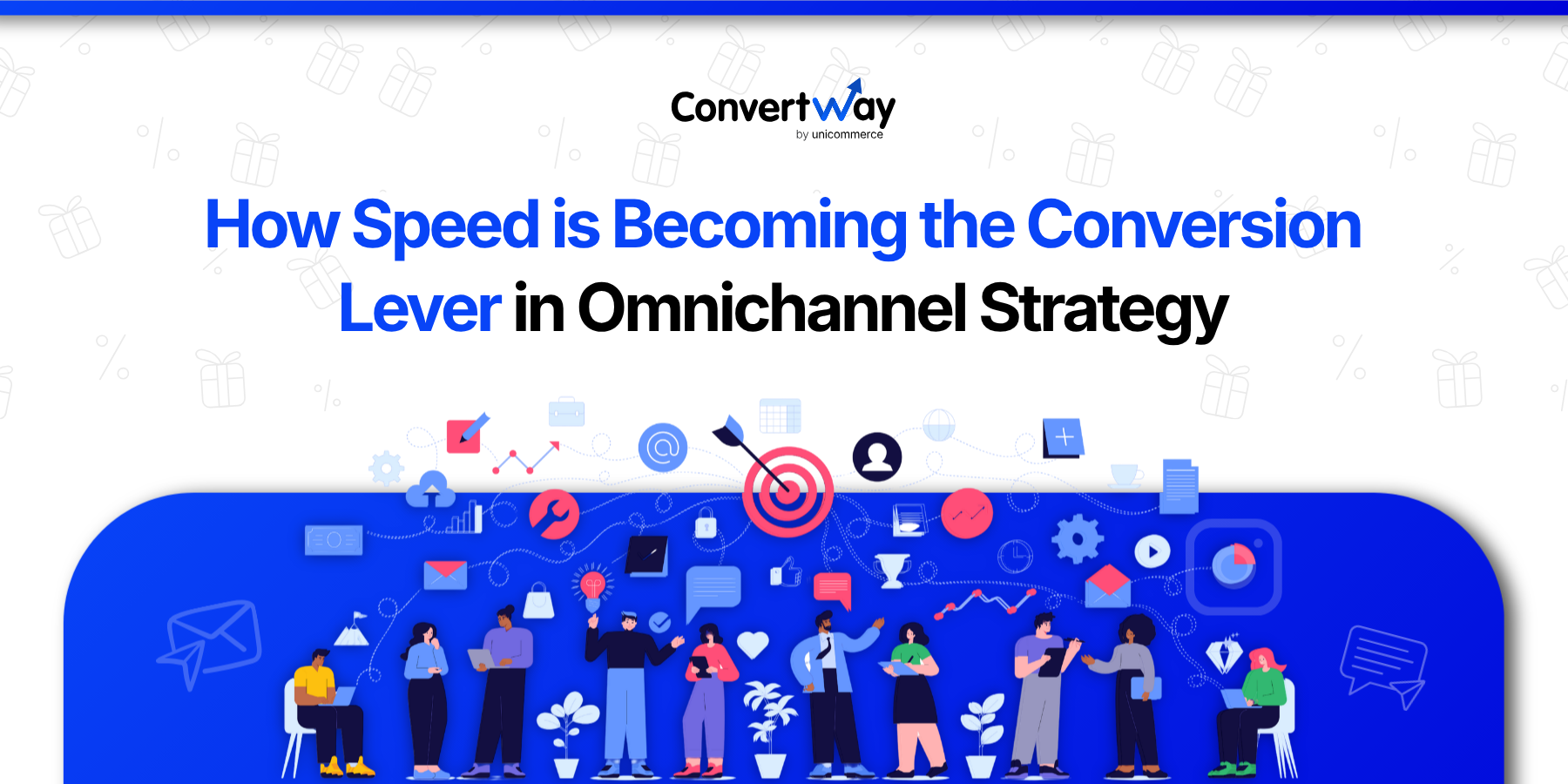
The brand that responds first does not just win the conversation. It wins the customer.
Here’s the thing: most brands building their omnichannel strategy in 2026 are focused on being present across more channels, platforms, and touchpoints. They’re chasing visibility.
And yet… they’re still not getting the response they expect. Because they’re missing the one thing that actually moves the needle: speed.
It’s not just about being everywhere. It’s about being available exactly when the customer needs you. Nail that, and the lead is yours. In fact, 82% of customers expect an immediate response when they have a sales query.
That’s the new standard. This is what defines omnichannel success in 2026 and beyond.
So how fast do you really need to be? And more importantly, what practical steps can you take to become more responsive, more connected, and 3× faster than your competitors?
In this blog, we’ll break it all down.
Being present on ten channels means nothing if you are slow on all of them. Because in a customer engagement strategy, it’s about how quickly you respond when the customer is ready.
Speed is not the entire strategy, but it quietly shapes how well everything else performs. Even the best campaigns, journeys, and personalisation efforts lose impact if the response comes too late.
This is not just a theory. Here’s the data that clearly supports it:
Slow lead response time creates a ripple effect across your entire customer journey. What looks like a small delay in one interaction quietly compounds into lost trust, lower conversions, and missed revenue at every stage.
Here is what is actually happening when your response is delayed:
Every minute of delay is a minute they spend somewhere else. The moment between a customer reaching out and getting a response is not neutral. They are:
A customer who waits hours for a response does not just feel ignored. They make a judgment about your brand. That judgment affects:
Every one of these moments shapes the digital customer experience your brand delivers, and a slow response can quietly undo even the most well-designed journey.
This directly affects your revenue as 78% of customers buy from the brand that responds first. That’s not a small advantage. It means the majority of customers choose the brand that simply shows up faster.
Here is where most brands get it wrong. They try to solve the speed problem by just sending faster messages. But speed without context is just noise.
Real-time customer engagement is not just about being quick. It is about sending the right message, to the right person, on the right channel, at the exact moment they actually need it.
Speed alone does not convert. Speed with relevance does.
"You left something behind! Here is 10% off."
This message went out fast. But it says nothing specific. It could have been sent to anyone. And because it feels like a bulk message, most customers scroll past it without a second thought.
"Hey, you were looking at the Blue Running Shoes in size 9. Only 3 pairs left. Want us to hold one for you?"
Same speed. But this message knows what the customer looked at, what size they needed, and creates urgency around something they actually wanted. That is what drives action or customer engagement strategy.
The difference between the two:
Digital customer experience in 2026 is not about adding more steps to your funnel. It is about removing the friction between the steps that already exist.
The biggest source of friction in most omnichannel strategies is the gap between when a customer acts and when your brand responds.
Run this three-step audit right now to find where your customer journey is slowest:
Write down every moment where a customer takes an action that needs a follow-up:
For each moment, measure how long it actually takes your brand to respond. Most brands are slower than they think:
For every gap you find, the solution is the same:
Here is the part most brands skip entirely when building their omnichannel strategy. They set up automation and assume it will always work, but sometimes it will not.
These are not edge cases. They happen every single day across every brand running automated flows.
The solution is a layered fallback system. When one channel fails, another one picks up immediately, without the customer ever feeling the gap.
Here is what a layered fallback flow looks like in practice:
Customer abandons cart. A WhatsApp message goes out within 30 minutes automatically
If the customer does not open WhatsApp within two hours, SMS goes out with the same offer.
If the customer still has not responded after 24 hours. Cart value is above your set threshold, and the Voice agent makes a personalised call the next morning.
If the customer still has not converted after 48 hours. Personalised email goes out with the product they looked at and a last-chance offer.
Result:
Actionable tip: Build your flows with fallbacks from day one. A three-layer flow will always outperform a single touchpoint, regardless of how good that single touchpoint is.
Most brands are managing customer conversations across WhatsApp, Instagram, and RCS from different places and losing context every time they switch. That is exactly the gap ConvertWay's omnichannel inbox solves.
ConvertWay's omnichannel inbox brings WhatsApp, Instagram, and RCS into one connected view so your team always knows the full story behind every conversation. No customer feels like they have to repeat themselves every time they reach out.
When your team responds faster, with full context, from one place, that is where omnichannel strategy stops being a theory and starts delivering real results.
Speed is not a technical upgrade. It is a strategic decision. And the brands making that decision right now are building a compounding advantage that will be very hard to close once it takes hold.
The brands that are winning in 2026 are not necessarily the ones with more channels. They are the ones who have removed friction, reduced response time, and built systems that never leave the customer waiting.
The tools are ready. The strategy is clear. The only thing left is to find the perfect omnichannel support for your brand, and ConvertWay fits as it builds a faster, more connected omnichannel strategy for your brand.
1. What is an omnichannel strategy in 2026?
An omnichannel strategy in 2026 means creating a connected experience across all customer touchpoints where every interaction is fast, consistent, and context-aware. It is not just about being present on multiple channels but about responding in real time with full visibility of the customer journey.
2. What is a major challenge of implementing an omnichannel strategy?
The biggest challenge is managing speed and consistency across channels. Most brands use multiple tools that do not talk to each other, which creates delays, breaks context, and leads to slow or disconnected responses.
3. What are customer engagement strategies?
Customer engagement strategies are methods brands use to interact with customers throughout their journey. In this context, it focuses on being fast, relevant, and consistent across all touchpoints to keep the customer interested and moving forward.
4. How does customer engagement strategy impact conversions?
A strong customer engagement strategy improves conversions by reducing delays and building trust. When customers get quick and relevant responses, they are more likely to take action, complete purchases, and return in the future.
5. What tools help improve digital customer experience?
Tools that bring all communication channels into one system, automate responses, and provide full customer context help improve the digital customer experience. They make interactions faster, smoother, and more connected for the customer.