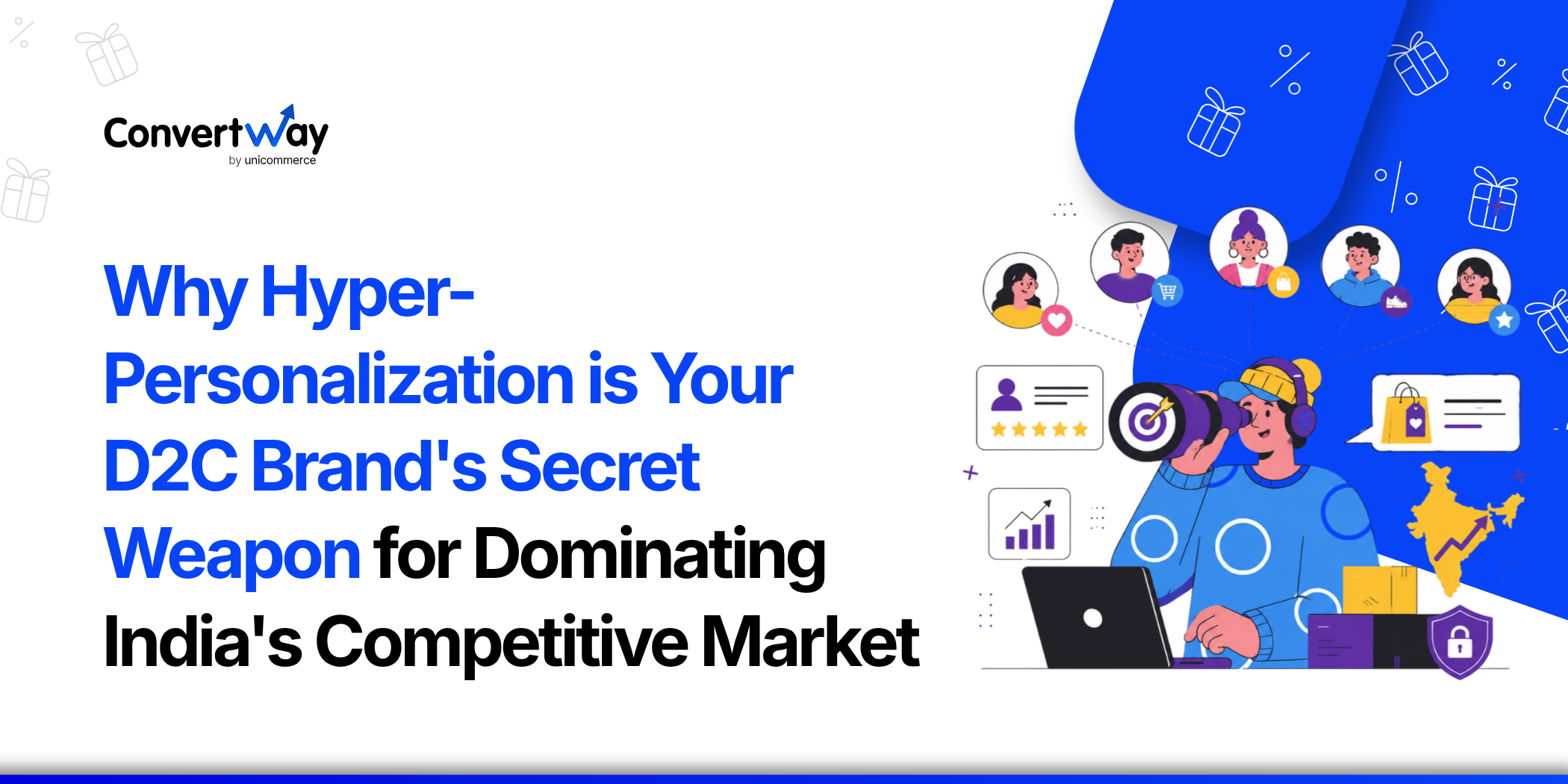
Most D2C founders in India don’t struggle because they lack marketing channels. The real issue is simpler and more expensive—they’re speaking to customers everywhere, but not actually understanding them anywhere.
A customer sees your Instagram ad, clicks through to your website, scrolls for a bit, leaves without buying, gets a discount email later, receives a WhatsApp reminder the next day, and maybe an SMS after that. On paper, it looks like a complete funnel. In reality, it feels like five different conversations happening in isolation.
That gap is where hyper-personalization starts to change everything.
Because there’s a big difference between sending a generic “Hey, here’s 10% off” and actually knowing that a customer checked the same running shoes twice, added them to cart, compared delivery timelines, and dropped off after seeing shipping charges. One is marketing. The other feels like understanding.
And in India’s D2C market right now, that difference is deciding who grows and who gets ignored.
Take a simple example of a skincare brand.
Two customers enter with the same intent—acne care.
But their behavior tells two completely different stories.
If both of them receive the same message, one of them will always feel slightly misunderstood.
That’s exactly the problem hyper-personalization solves.
Instead of pushing fixed campaigns, it reacts to behavior in real time:
The shift is subtle but powerful.
You stop treating people like segments and start treating them like evolving intent patterns.
India is in a very unique position when it comes to digital commerce.
WhatsApp isn’t just a messaging app here—it’s already a buying and decision-making channel.
So when brands use it well, it doesn’t feel like marketing. It feels like a continuation of a conversation.
For example:
Layer in cultural timing, and things become even more interesting. Shopping behavior in India is deeply contextual. People don’t just buy because of discounts—they buy because the moment feels right.
That’s why brands that understand intent outperform brands that only push offers.
They’re not just segmenting audiences. They’re responding to behavior.
One of the biggest mistakes brands make is trying to personalize everything at once. That usually creates noise instead of clarity.
A better approach is to start where intent is already visible.
Your website already tells you what customers want.
Even small changes—like showing different homepage content for returning users—can make the experience feel instantly more relevant.
Email works best when it adapts to the customer’s stage.
The mistake most brands make is sending the same journey to everyone.
WhatsApp is where relevance becomes real-time.
Here, timing matters more than creativity.
When all three channels respond to the same logic, the experience stops feeling fragmented.
It starts feeling connected.
Hyper-personalization looks like messaging on the surface, but underneath it is a data problem.
Most D2C brands already collect enough data to personalize well.
The issue is simple: it’s scattered everywhere.
When data is disconnected, decisions become guesses.
And guessing doesn’t scale.
The second challenge is understanding behavior over time.
Not just what a customer did once, but how their intent changes.
Even basic behavioral logic makes communication significantly more relevant.
Hyper-personalization doesn’t need to start with heavy systems or complex models.
In fact, the best results usually come from simple behavior-based rules.
For example:
Nothing complicated. Just structured responses to real actions.
Once this foundation is in place, automation handles execution across WhatsApp, email, and SMS without manual effort every time.
The goal is not more campaigns.
It is fewer, smarter journeys that run in the background.
When hyper-personalization is done right, the impact doesn’t show up as one big metric.
It shows up in behavior shifts.
Over time, customers stop feeling “marketed to.”
They start feeling understood.
And that’s where lifetime value quietly improves—without forcing discounts everywhere.
The next phase of D2C growth in India isn’t about who can acquire the most customers.
It’s about who can understand them deeply enough to keep them longer.
Every brand can run ads.
Very few can respond intelligently after the first click.
Hyper-personalization is what closes that gap.
It turns scattered interactions into connected journeys that evolve with customer behavior.
And once customers experience that level of relevance, generic messaging doesn’t disappear—it just stops working.
The brands that win won’t be the loudest in the market.
They’ll be the ones who feel the most in sync with their customers.
FAQs
1. What is hyper-personalization in D2C marketing?
Hyper-personalization in D2C marketing is a strategy where every customer interaction is shaped by real-time behavior, intent, and engagement instead of static segmentation. Instead of sending one message to everyone, brands use live signals like browsing activity, cart behavior, and purchase history to deliver relevant communication. This strengthens customer experience automation because every interaction feels timely and context-aware, improving engagement across WhatsApp, email, and website journeys.
2. How is hyper-personalization different from regular personalization?
Regular personalization relies on fixed data such as name, location, or past purchase. Hyper-personalization adapts dynamically based on what the customer is doing in the moment. For example, two users may have purchased earlier, but if one is actively browsing products while the other is inactive, they should receive completely different messaging. This makes D2C personalization strategies more effective because communication reflects real intent instead of static assumptions.
3. Which channels are most effective for hyper-personalized campaigns?
The most effective channels are WhatsApp, email, and websites because they cover the full customer journey from discovery to conversion. WhatsApp is strongest for real-time engagement, email works well for structured lifecycle communication, and websites help shape discovery based on behavior. When combined under an omnichannel marketing India approach, these channels ensure consistent and relevant messaging across every touchpoint.
4. What data do D2C brands need for hyper-personalization?
Brands need behavioral, transactional, and engagement data to build effective personalization systems. This includes product views, cart actions, purchase frequency, time spent on pages, and responses to previous campaigns. When this data is unified, it becomes the foundation for customer experience automation. It also helps brands understand intent patterns like repeat purchase probability or churn risk, improving personalized customer journey planning.
5. How does hyper-personalization impact revenue in D2C brands?
Hyper-personalization improves revenue by increasing relevance at every stage of the funnel. When customers receive timely and context-driven communication, they are more likely to convert and return. Over time, this leads to stronger conversion rates, higher repeat purchases, and better customer retention. It also reduces dependency on discounts because engagement is driven by relevance rather than incentives.
6. How do you implement hyper-personalization without complex systems?
Implementation can start with simple behavior-based triggers rather than complex systems. Brands can begin by sending follow-ups when users view a category multiple times, adjusting cart abandonment messages based on timing, and reactivating inactive customers with relevant offers. As the system matures, automation tools help scale these actions across WhatsApp, email, and SMS. This enables customer experience automation without increasing manual workload while maintaining consistency across channels.