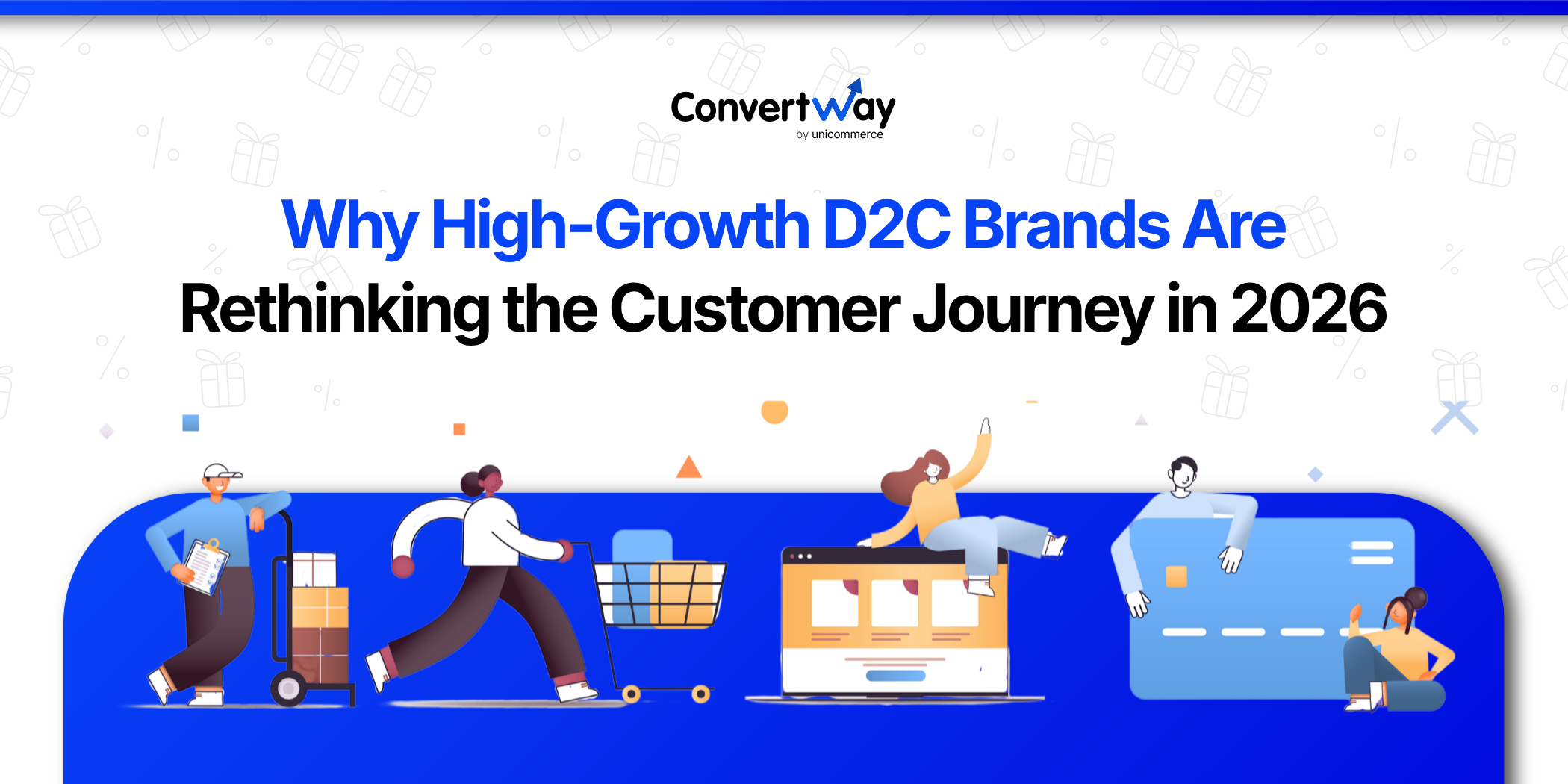
A customer discovers your brand through Instagram, visits your website, opens a WhatsApp reminder later, clicks an email the next day, and finally converts after receiving an SMS offer. For customers, this feels like one continuous experience. But most D2C brands still manage these touchpoints as separate marketing activities.
That disconnect creates a major growth problem in 2026. Customers' journey now moves constantly between WhatsApp, email, SMS, social media, and websites, and before making a purchase, while 73% of consumers expect brands to understand their preferences and behavior. Yet many D2C brands still struggle to identify which touchpoints actually influence conversions.
And here, customer journey mapping has become essential for modern D2C growth. Brands that understand how customers move across channels, where they drop off, and what drives action are building stronger retention, better engagement, and higher conversions across the entire buying journey.
So, this blog breaks down:
Customer journey mapping is the process of understanding how customers interact with your brand across different channels and stages before making a purchase.
For D2C brands, every touchpoint shapes the buying decision. This often includes:
But the real purpose of customer journey mapping is to understand:
A traditional sales funnel only shows broad stages like awareness, consideration, and purchase. Customer journey mapping goes much deeper. It reveals what customers are actually doing between those stages, how they move across channels, and why some journeys convert while others do not.
For D2C brands in 2026, that visibility is becoming essential. Because the brands that understand customer journeys better are the ones improving retention, increasing conversions, and building stronger long-term customer relationships.
D2C growth has become significantly more competitive over the last few years. Customers now move faster between platforms, expectations around personalization are higher, and acquisition costs continue to rise across paid channels. That disconnect creates major growth challenges for D2C businesses.
So, below are the reasons why modern D2C brands need a journey-led marketing strategy now:
Most D2C operators already understand the pressure of rising customer acquisition costs. But many brands still focus more on driving traffic than improving the journey after customers arrive. This creates expensive inefficiencies throughout the buying process. Sometimes customers are already ready to purchase, but the experience breaks because:
Customer journey analytics helps brands identify these gaps clearly. Instead of relying on assumptions, teams can respond based on actual customer behavior and intent signals.
Today’s customers naturally move across multiple channels before making a purchase. Customers also expect brands to remember these interactions. When communication feels repetitive or disconnected, trust drops quickly. This is why the brands growing fastest are creating continuity across:
Brands often struggle to understand which touchpoint actually influenced the conversion. Was it the Instagram ad that created awareness? The WhatsApp reminder that brought the customer back? Or the SMS discount that finally triggered the purchase?
In reality, most conversions happen because multiple touchpoints work together over time. Customer journey mapping helps brands understand the complete buying path instead of giving all the credit to the final click.
That visibility leads to:
But how do you actually create connected customer journeys across all your channels? Let’s understand step by step.
Modern D2C customer journeys move between channels depending on convenience, timing, and intent. That is why brands should focus on creating connected journeys instead of isolated campaigns.
The best customer journeys begin with real customer actions.
For instance:
Every communication channel plays a different role in the customer journey.
Customers should feel like they are having one continuous experience with your brand.
For instance, if a customer ignores an email, the journey can continue through WhatsApp later. If they have already purchased, promotional reminders should automatically stop. This is where connected automation becomes important for improving customer experience.
Or instead of managing every touchpoint manually, D2C brands can also use customer journey mapping tools that make it easier to build, automate, and manage omnichannel journeys across WhatsApp, email, SMS, and other customer touchpoints.
In 2026, the customer journey mapping platform should actively help brands improve conversions, retention, and customer experience across every touchpoint.
So, let’s see what makes a customer journey mapping tool perfect for D2C brands:
A customer journey platform should integrate directly with the tools your business already uses, including:
Without real-time syncing, customer experiences quickly become disconnected. For instance, sending abandoned cart reminders after a customer has already purchased creates immediate friction.
Modern D2C journeys happen across multiple touchpoints. Brands need visibility across:
This helps teams understand how channels work together instead of operating in silos.
Customer journey mapping should drive action, not just reporting. The best platforms allow brands to automate engagement based on customer behavior, such as:
As customer journeys become more fragmented across channels, D2C brands need platforms that can connect customer interactions, automate engagement, and improve conversions in real time.
Today, the most effective customer journey platforms focus on:
Platforms like Convertway are increasingly helping D2C brands build connected customer journeys by combining multi-channel automation with real-time engagement and behavioral targeting.
For growing D2C brands, the ideal platform is not just a reporting tool. It should actively help teams reduce drop-offs, improve retention, and create seamless customer experiences across every touchpoint.
Once you implement these customer journey mapping tools and journeys, the next step is measuring whether they are actually improving customer experience and conversions. Here are some key metrics every D2C brand should track.
Customer journey mapping only becomes valuable when brands can measure performance clearly. Instead of tracking isolated campaign metrics, D2C brands should evaluate how the full journey influences customer behavior.
Some of the most important metrics include:
Brands should also identify where customers drop off most frequently and which touchpoints contribute most to conversions.
Customer journeys have become far more complex for D2C brands in 2026. Customers move continuously across WhatsApp, email, SMS, websites, and social media before making decisions. Brands that still manage these touchpoints separately risk creating disconnected experiences, lower engagement, and weaker retention.
Customer journey mapping helps solve that problem by giving brands visibility into how customers actually behave across channels.
And when combined with automation, personalization, and real-time engagement, it becomes one of the strongest drivers of modern D2C growth.
FAQs:
1. What is customer journey mapping for D2C brands?
Customer journey mapping is the process of tracking and understanding how customers interact with a D2C brand across channels like WhatsApp, email, SMS, social media, and websites before making a purchase. It helps brands improve customer experience, conversions, and retention by identifying drop-off points and engagement patterns.
2. Why is customer journey mapping important for D2C brands?
Customer journey mapping helps D2C brands understand customer behavior across multiple touchpoints, improve omnichannel customer experience, reduce drop-offs, and create personalized marketing journeys that increase conversions and customer lifetime value.
3. How do you create an omnichannel customer journey?
To create an omnichannel customer journey, D2C brands need to connect channels like WhatsApp, email, SMS, websites, and social media into one unified experience. This includes tracking customer actions, building behavioral automation, and delivering personalized communication at every stage of the journey.
4. What are the best customer journey mapping tools for D2C brands?
The best customer journey mapping tools for D2C brands are platforms that support omnichannel automation, real-time customer tracking, behavioral segmentation, and integrations with Shopify, WhatsApp, email, and SMS marketing systems.
5. How do customer journey mapping tools improve conversions?
Customer journey mapping tools improve conversions by helping brands identify customer drop-offs, automate follow-ups, personalize messaging, recover abandoned carts, and optimize customer engagement across multiple channels.
6. What metrics should D2C brands track in customer journey mapping?
D2C brands should track metrics like conversion rate, customer lifetime value, retention rate, cart abandonment recovery, engagement across channels, and multi-channel attribution to measure customer journey performance effectively.