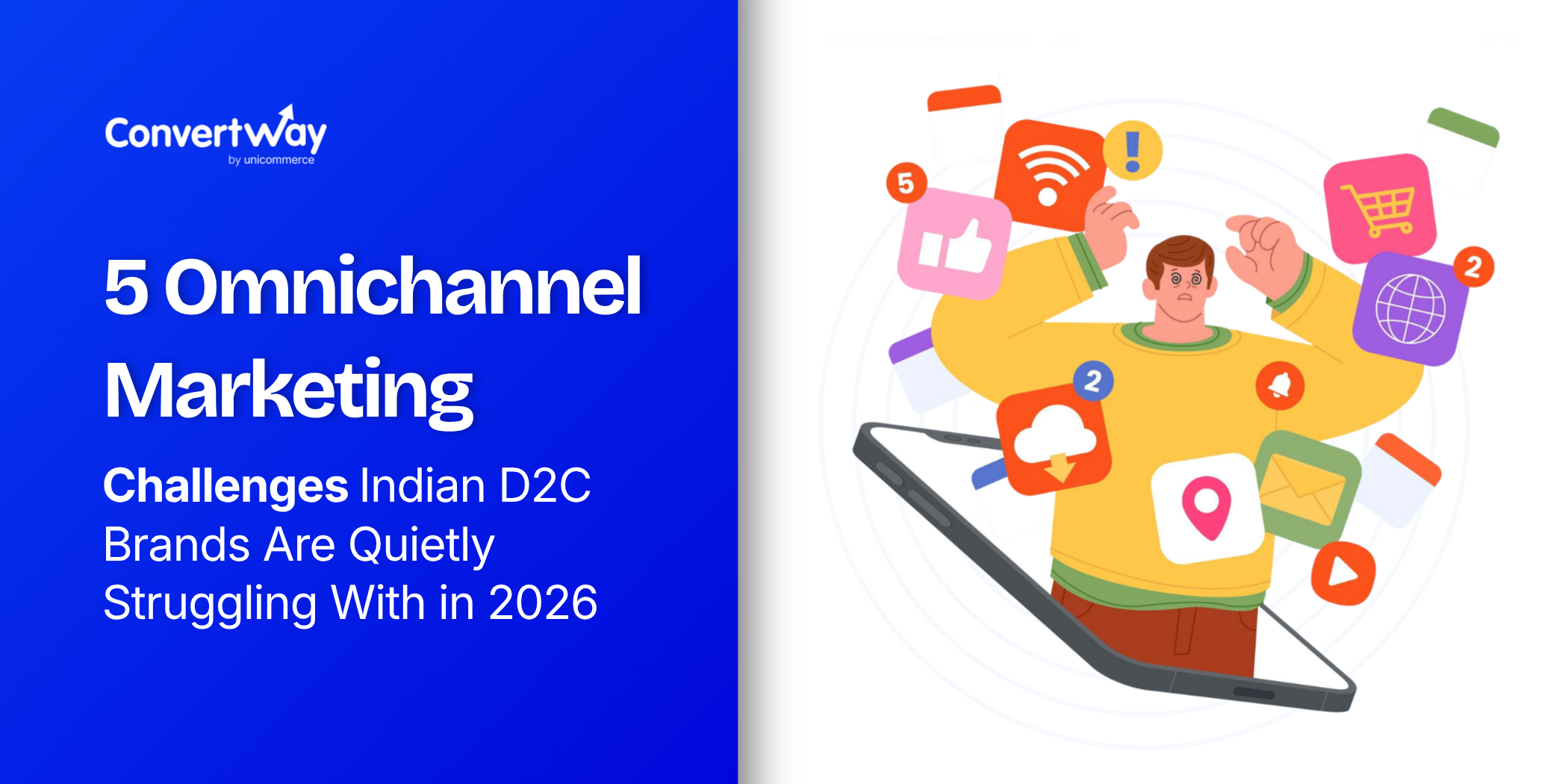
During a festive sale, a growing beauty brand in Jaipur noticed something confusing. Website traffic was strong, Instagram ads were driving clicks, and WhatsApp campaigns were getting solid engagement, yet repeat purchases had started falling.
The team blamed competition, discounts, and even ad fatigue until they realized the real issue was much simpler: customers were getting a different experience on every channel. The website showed one offer, WhatsApp support shared another, emails promoted products customers had already purchased, and delivery communication stayed inconsistent.
This problem is faced by so many brands as they are active across multiple channels, but making those channels work together smoothly is becoming the real challenge affecting retention, profitability, and long-term customer trust.
Let’s look at the biggest omnichannel marketing challenges Indian D2C brands are facing in 2026 and how brands are solving them.
Today, customers constantly move from Instagram to marketplaces, WhatsApp to email, and they expect the experience to stay connected throughout. A customer may discover a product through a creator video, ask questions on WhatsApp, compare pricing on the website, and finally purchase after receiving a reminder email.
The pressure on brands is becoming even higher because:
In short, brands are now competing on customer experience quality. Let’s understand the biggest Omnichannel marketing challenges behind this shift in detail.
Marketing teams see ad engagement, support teams see complaints, CRM tools track email activity, and ecommerce dashboards track purchases, but nobody sees the complete customer journey together. This creates situations where:
For instance, a customer discussing a delayed order on WhatsApp may still receive promotional upsell emails at the same time, which immediately damages trust.
What Smart D2C Brands Are Doing
Instead of managing customer data separately across channels, brands are building unified customer profiles where purchase history, browsing behavior, campaign engagement, and support conversations work together. This gives teams better visibility and improves personalization naturally.
Today, customers expect updates, recommendations, COD verification, support, and post-purchase engagement all on WhatsApp. The omnichannel marketing challenge is that many brands still manage it manually.
What Smart D2C Brands Are Doing
Brands are embedding WhatsApp into full customer journeys instead of using it as a standalone channel.
This shift improves speed, relevance, and engagement because customers are already highly active on WhatsApp throughout the day.
Consumer behavior varies sharply across regions. Some customers prefer prepaid orders, while others depend on Cash on Delivery. WhatsApp works better in some regions, while SMS drives higher engagement in others. Even language preferences change the way customers respond.
What Smart D2C Brands Are Doing
Instead of treating India as one uniform market, brands are localizing communication based on region and behavior.
A customer in Kanpur should not experience the brand the same way as a customer in Mumbai. The brands scaling faster are the ones adapting to these differences instead of ignoring them.
The problem is that modern customer journeys rarely stay on a single channel. A customer might discover a brand on Instagram, revisit it on Google, ask a few questions on WhatsApp, and finally purchase after receiving an email reminder. So it becomes unclear which channel actually drove the conversion.
What Smart D2C Brands Are Doing
Instead of relying only on last-click attribution, brands are shifting to full journey analysis.
This gives a more realistic view of what actually drives revenue over time, not just the final click.
As D2C brands scale, campaign execution quickly becomes messy. Meta ads, influencer campaigns, WhatsApp, email, and support all run in separate silos, and teams end up spending more time coordinating than actually improving performance.
This slows everything down. Cart recovery gets delayed, hot leads lose momentum, follow-ups become inconsistent, and customers often receive duplicate messages across channels.
What Smart D2C Brands Are Doing
Brands are shifting from manual campaign execution to automated customer journeys where behavior drives communication.
To solve these omnichannel marketing challenges, you need a proper tool that can handle everything without costing too much, and Convertway is one of the best options among them. What features do they offer? To understand, check the next section!
Most Omnichannel marketing challenges happen because the systems they rely on don’t talk to each other. That’s where platforms like Convertway help simplify customer engagement. Instead of managing WhatsApp, email, SMS, automation, and customer journeys separately, brands can bring everything into one connected system.
For growing D2C businesses, this helps solve key operational challenges together:
The real advantage is operational simplicity. When teams don’t have to constantly switch between disconnected tools, they can focus more on improving customer experience and driving growth.
Indian D2C brands are entering a phase where customer experience quality directly influences long-term growth. Customers already behave in an omnichannel way naturally. They browse across platforms, compare information everywhere, switch devices constantly, and expect communication to feel connected.
The brands growing fastest in 2026 are the brands removing omnichannel marketing challenges from customer journeys. And in a highly competitive ecommerce market, smoother experiences quietly become one of the strongest competitive advantages a brand can build.
FAQs
1. What are the biggest omnichannel marketing challenges for D2C brands?
The biggest omnichannel marketing challenges include disconnected customer data, inconsistent messaging, manual campaign management, attribution issues, regional language gaps, and fragmented communication across channels.
2. Why do omnichannel marketing strategies fail for ecommerce brands?
Many ecommerce brands use separate tools for WhatsApp, email, SMS, and analytics without proper integration. This creates disconnected customer experiences and operational inefficiencies.
3. How does WhatsApp help omnichannel marketing in India?
WhatsApp helps brands improve customer engagement through faster communication, automated support, order updates, cart recovery, and personalized campaigns.
4. Why is regional language support important for Indian D2C brands?
Regional language communication improves customer trust and engagement, especially in Tier-2 and Tier-3 markets where customers often prefer local-language interactions.
5. How can brands measure omnichannel marketing ROI?
Brands can measure omnichannel ROI using customer lifetime value, assisted conversions, retention rates, repeat purchases, and complete customer journey analytics.
6. What tools help solve omnichannel marketing problems?
Integrated omnichannel platforms that combine WhatsApp, email, SMS, automation, analytics, and customer data management help brands improve coordination and customer experience.