
"Why are conversions dropping?" If you manage marketing campaigns for a D2C brand, this is probably one of the most common questions you hear from your founder or marketing head.
The first instinct is often to increase the ad budget, refresh creatives, or launch another campaign. While these changes may improve performance temporarily, they rarely solve the actual problem. In most cases, customers drop off somewhere in the buying journey. They click on your ad but leave because the landing page does not match their expectations.
To bring them back, you need to optimize your campaigns based on customer intent. Campaign optimization improves every stage that influences a customer's buying decision. And for that, you don't have to increase your budget. Sometimes, optimizing the campaign you already have delivers better results than spending more on ads.
In this blog, we will discuss the best practices you can use for campaign optimization. Let’s read on!
Campaign optimization is the process of improving every part of your marketing campaign to achieve better results. Instead of simply increasing your ad budget, it focuses on identifying what is working, fixing what is not, and making your existing campaigns more effective.
The goal depends on what your business wants to achieve. For some brands, it means increasing conversions. For others, it could be improving return on ad spend (ROAS), reducing customer acquisition costs, or building brand awareness.
In simple words, campaign optimization helps you get more value from every marketing rupee you spend. By analyzing campaign performance, testing different strategies, and continuously improving the customer journey, you can increase conversions without always spending more on advertising.
According to the Sellers eCommerce Report, global eCommerce sales reached $7.4 trillion in 2026. Around 34% of shoppers now make an online purchase at least once a week. As competition grows, brands need to optimize every campaign to improve conversions and make better use of their marketing budget.
Campaign optimization helps you achieve that by improving every stage of the customer journey. Instead of making random changes whenever campaign performance drops, you can identify where customers leave the buying journey, fix those gaps, and improve overall campaign performance.
Many brands think campaign optimization only means improving ads. In reality, every stage of your marketing funnel affects conversions. If one stage performs poorly, it impacts the overall campaign.
Here's what you should focus on:
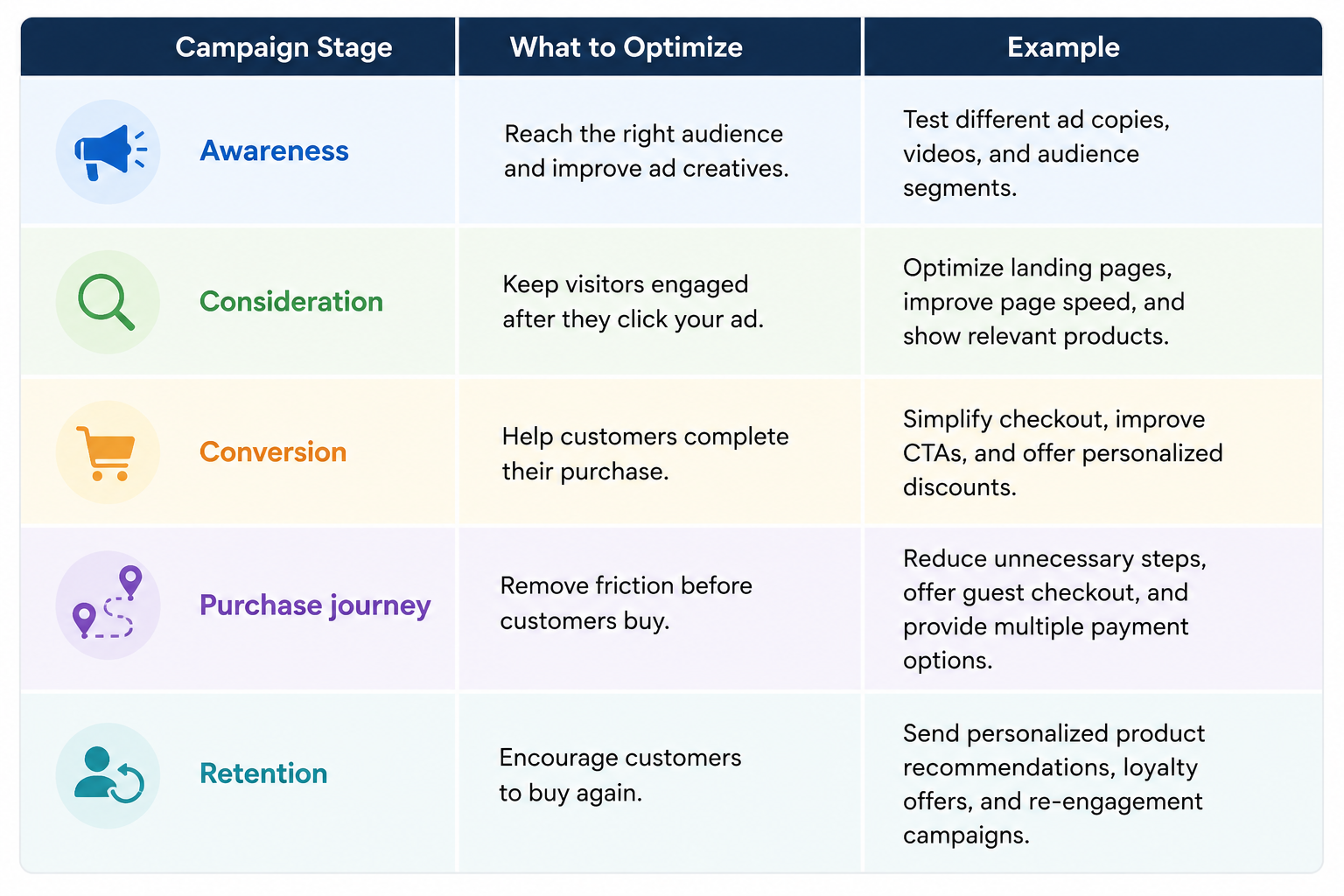
No matter how good your ads are, they cannot deliver the expected results if customers leave your website before completing their purchase. The best-performing campaigns optimize every stage of the customer journey instead of focusing on just one part.
From setting the right campaign goal to re-engaging customers who leave without buying, every small improvement helps increase conversions and maximize your return on investment (ROI).
Here are 10 practical campaign optimization strategies every D2C brand should follow.
Before launching a campaign, decide what action you want customers to take. It could be completing a purchase, adding products to their cart, or placing a repeat order. Once the goal is clear, you can build the audience, creatives, and landing page around it.
For instance, if your goal is to recover abandoned carts, every message should encourage customers to complete their purchase instead of introducing new products.
Not every customer is ready to buy. Sending the same campaign to everyone usually reduces engagement and wastes your marketing budget. Instead, divide your audience based on their behavior, purchase history, browsing activity, or lifecycle stage.
For example, first-time visitors may need product education, while repeat customers may respond better to exclusive offers or loyalty rewards. Customers who abandoned their cart may only need a timely reminder to complete the purchase.
Compare different headlines, creatives, offers, CTAs, or landing pages to understand what actually improves conversions. Small improvements made consistently often deliver better long-term results than one major campaign change.
If your ad promotes a "Flat 40% Off Footwear Sale," customers should land directly on that collection instead of your homepage. A relevant landing page with a fast loading speed, clear product information, and an easy-to-find CTA helps reduce drop-offs and improves conversions.
Show customers offers based on their interests instead of sending the same discount to everyone. Personalized recommendations, category-specific offers, and product bundles often generate better engagement and conversions.
Focus on customers who already viewed products, added items to their cart, or purchased before. Timely reminders, personalized messages, or limited-time offers can encourage them to complete their purchase.
Every extra step in the checkout process increases the chances of losing a customer. Simplify forms, offer guest checkout, support multiple payment options, and create a faster buying experience.
Limited-time offers, low-stock alerts, and countdown timers encourage customers to act sooner. Use them only when they are genuine so customers continue to trust your campaigns.
Show customer reviews, ratings, return policies, delivery timelines, and secure payment badges where customers make their purchase decision. These trust signals reduce hesitation and improve conversions.
Track important metrics like CTR, conversion rate (CVR), CPA, ROAS, bounce rate, and cart abandonment to identify where customers leave the buying journey. Use these insights to optimize your campaigns and improve ROI.
Every strategy discussed above works best when it is executed consistently. But manually tracking customer behavior, sending follow-ups, and personalizing every campaign becomes difficult as your business grows. Convertway helps automate these tasks and helps you engage the right customers at the right time and improve conversions without increasing your ad spend.
Convertway is an automation platform that helps D2C brands engage customers throughout their buying journey. From customer segmentation and personalized campaigns to automated cart recovery and customer-based message timing, it offers everything you need to optimize your marketing campaigns from one platform.
Instead of manually following up with every customer, Convertway automates customer engagement based on their behavior and purchase intent. This helps brands recover more abandoned carts, improve conversions, increase repeat purchases, and maximize returns from their existing marketing budget.
If you're looking to turn more clicks into customers and make every campaign more effective, Convertway helps you put these campaign optimization strategies into action with ease.
Every campaign has room for improvement. The key is knowing where customers lose interest and fixing those gaps before increasing your marketing budget. Whether it is better audience segmentation, a more relevant landing page, personalized offers, or timely follow-ups, each optimization helps move more customers toward a purchase.
For strategy, test what works, measure the results, and keep improving over time. Small changes made consistently often deliver better results than completely changing your campaign strategy.
As competition continues to grow, brands that optimize every stage of the customer journey will always have an advantage. The sooner you start improving your campaigns, the sooner you'll see higher conversions, better ROI, and more value from every marketing rupee you spend.
FAQs:
1. What is campaign optimization?
Campaign optimization is the process of improving different parts of a marketing campaign to achieve better results. It involves refining audience targeting, campaign messaging, landing pages, offers, and follow-ups to increase conversions, improve ROI, and make better use of your marketing budget.
2. What is a good campaign optimization score for Google Ads?
A good Google Ads Optimization Score is generally 80% or above. However, the score alone should not determine campaign success. Focus on business metrics like conversions, ROAS, CPA, and revenue to evaluate whether your campaigns are delivering the expected results.
3. What are the most successful ad campaigns?
The most successful ad campaigns are those that reach the right audience with the right message at the right time. They combine clear campaign goals, compelling creatives, relevant landing pages, personalized offers, and continuous optimization to maximize conversions and ROI.
4. What are the latest trends in ad campaigns?
Some of the latest ad campaign trends include AI-powered audience targeting, personalized marketing, first-party data strategies, omnichannel campaigns, short-form video ads, WhatsApp marketing, and marketing automation. Brands are also focusing more on customer retention and personalized follow-ups to improve conversions.
5. What are the best campaign optimization strategies?
Some of the best campaign optimization strategies include setting a clear conversion goal, segmenting your audience, running A/B tests, optimizing landing pages, personalizing offers, retargeting high-intent customers, simplifying the checkout process, creating genuine urgency, building trust with reviews, and tracking campaign performance regularly.
6. What metrics should I track for campaign optimization?
You should track key metrics such as click-through rate (CTR), conversion rate (CVR), return on ad spend (ROAS), cost per acquisition (CPA), bounce rate, cart abandonment rate, and customer lifetime value (CLV). Monitoring these metrics helps you identify performance gaps and optimize your campaigns more effectively.



.png)