Today’s customers are constantly asking themselves one simple question: “Is this brand really for me?” They care deeply about how a brand treats them and how quickly it responds to their needs.
That is why artificial intelligence and the proliferation of innovative technologies have become the cornerstone of almost all successful direct-to-consumer (D2C) brands. Today, AI is a way to stay ahead of competitors, engage customers instantly, and drive revenue like never before. From chatbots to advanced AI features, technology is now transforming how businesses communicate with their customers.
AI technology has now emerged as a method of communicating with customers, whether it’s a chatbot or any other modern feature. From improving lead response time to handling complex customer questions, AI is moving beyond automation.
Due to the rapid expansion of AI and the multiple advances in technology, the following customer expectations of D2C brands have been raised:
To assist with this, it upgraded its services to include Voice Agent, which offers real-time support and insight into product tracking. The Voice Agent compresses the purchasing process into a handful of vocalizations, enabling businesses to verify COD orders and reduce RTOs without concern.
But why exactly do modern businesses need this? How can it help you recover lost sales and stay ahead of competitors? For that, here’s the blog post with all the details you need to advance your business and generate revenue while standing out from competitors.
This blog will cover -
What is a Voice Agent?
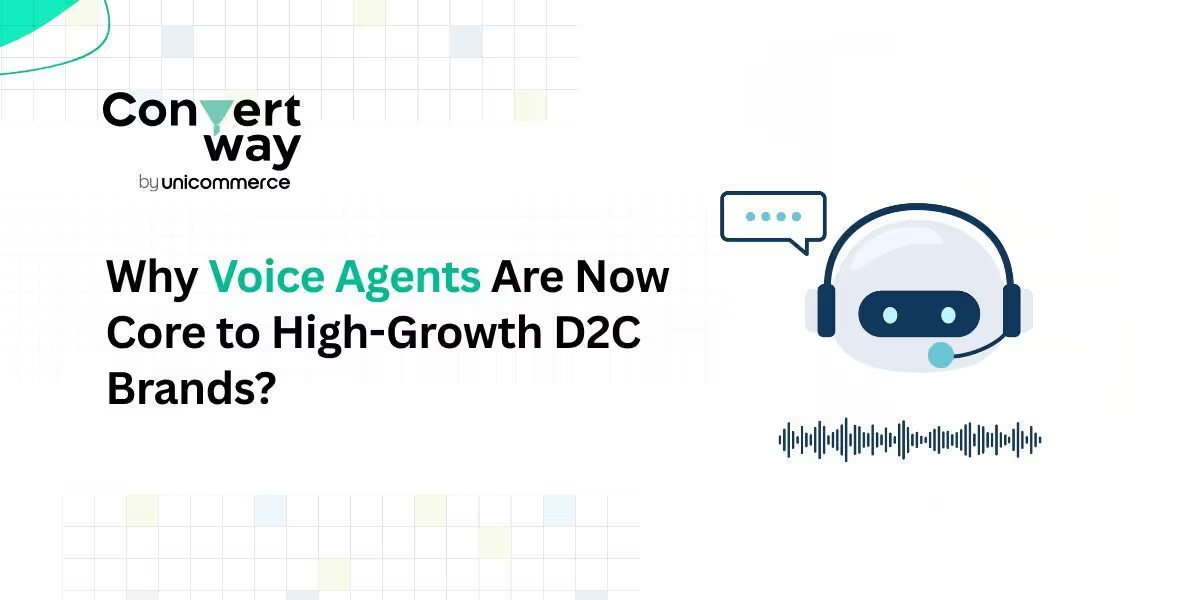
An AI-powered voice agent that uses conversational language to interact with customers and eliminate all barriers to communication between the business and the customer. Think of it as a virtual sales assistant that can respond instantly and intelligently.
An example of questions it can handle with ease includes:
It provides personalized, contextually relevant responses to each customer's inquiry. The result of this interaction is that it eliminates the need for multiple stages in an ongoing conversation, creating a more streamlined, immediate response that yields actionable results. Therefore, customers can receive their answers quickly, enhancing customer engagement and increasing conversion rates.
How AI Voice Agents Address High-Impact Business Challenges?
Think about your last time shopping online when you had a question that needed answering quickly. Perhaps your inquiry was something relatively straightforward, such as "Will this get to me before the weekend?"
Imagine now waiting... Waiting... Waiting... And continuing to wait for any real response. The frustration of waiting what seems like an eternity and feeling that "they don't care" is where the vast majority of D2C brands are losing out on potential repeat business.
The long wait times, generic written responses, and awkward interactions all contribute to pushing potential purchasers away. When brands attempt to compensate for these delays by simply throwing more bodies at the situation, it often has the opposite effect. Teams become inundated with repeat phone calls and confirmations, leaving less time to develop innovative products. An AI will therefore provide a straightforward, quick, and concise answer, thereby transforming the way a brand operates.
Before we talk about how AI agents with voice help, let’s look at the everyday challenges D2C brands face:
These are just some of the challenges. When businesses rely on outdated tactics and manual processes, they often miss high-intent opportunities and lose revenue. And for that, AI helps brands engage customers better and operate more profitably.
Voice agents are a modern, practical solution. Here’s how they solve these problems in real time:
And there’s much more. Here’s a detailed look at its key use cases and how they drive real impact.
What Are the Key Use Cases of an AI Voice Agent?
Marketing is entering a bifurcated era. Brands that change early will be at the front, and those that do not change will end up at the back. To stay competitive, you must take your customers' needs beyond what they want and provide them with instant and meaningful interactions.
Thus, it becomes an incredibly valuable partner that will always be there for your customer, take the initiative to help them, answer their questions, and assist them with products and services all in one conversation.
Here are three detailed use cases:
1. Reduce RTO by Automating COD Verification
Cart abandonment is a major challenge, with rates reaching over 70% in 2025. When high-intent customers are left unattended, businesses lose both sales and revenue.
With an AI voice agent, the business can address abandoned cart and COD orders through proactive follow-up by providing customers with the information they need to make a purchase decision, such as price, offers, product usage/ingredients, delivery dates, and so forth.
As it pertains to COD orders, it confirms the order and delivery information before shipping, helping ensure fewer unverified orders and reducing RTO losses.
Key Benefits:
2. Sales Assistance Through Natural Conversations
While AI is great at managing routine interactions, studies show that 75% of consumers still prefer to speak with a human for complex issues. Voice agents powered by artificial intelligence close this void by enabling human-like conversational interaction, thereby enhancing their capability to manage complex inquiries and emotions.
They also enable automatic follow-up communications in the event a customer disconnects, calling the customer at 24-hour intervals after the first attempt to prevent potentially high-intent communications from being overlooked.
Key Benefits:
3. Personalized Engagement
Today’s customers expect a personal touch. In fact, 76% say personalization makes them feel more connected to a brand. Through AI Agents with voice capabilities, businesses can deliver personalized offers and recommendations based on customers' preferences. It can automatically switch languages throughout the conversation as needed, so the customer feels the discussions are seamless and the messages are conveyed perfectly.
Key Benefits:
How Convertway’s AI Voice Agent Fits Into a Modern Business Stack?
Conversational AI can change how customers view excellent customer service, as their expectations evolve into a new way to connect with brands. To be successful, brands must have a solution that combines intelligent automation with true, human-like interactions or experiences. ConvertWay’s AI Voice Agent is what makes it different and enables it to help brands scale honest, authentic customer conversations without detracting from the experience.
So why should brands trust ConvertWay? Here’s what sets it apart:
So, ConvertWay has many features to help D2C brands convert high-intent leads into long-term customers. In addition to conversion, ConvertWay will increase ROI on your marketing spend and revenue by removing barriers to scale and engaging customers. By automating critical touchpoints and delivering consistent, human-like interactions, ConvertWay enables brands to operate more efficiently while building stronger customer relationships.
FAQs:
1. What is an AI Voice Agent?
An AI voice agent is an intelligent, conversational system that interacts with customers through natural voice conversations. Unlike traditional IVRs or scripted bots, a voice agent understands intent, responds in real time, and handles customer questions just as a human sales or support executive would.
2. What challenges do D2C brands face daily, and how does a voice agent solve them?
D2C brands commonly struggle with high cart abandonment, unverified COD orders leading to RTO, delayed responses to high-intent leads, and heavy dependence on manual calling teams. A voice agent addresses these challenges by instantly calling customers at critical moments, answering objections in real time, confirming COD orders before shipment, and automatically following up.
3. What are the key use cases of a voice agent?
A voice agent supports multiple high-impact use cases across the customer journey. It instantly calls users who abandon carts to resolve objections, automates COD confirmation and address verification, and scales outbound calls to thousands of customers simultaneously. It also shares product details, delivery timelines, offers, and sizing or usage guidance, helping customers move from hesitation to purchase faster.
4. How should a business choose the right voice agent?
When choosing a voice agent, businesses should look for human-like conversation quality, real-time response capability, outbound calling support, and strong contextual understanding of products and orders. Multilingual support, automated follow-ups, personalization capabilities, and easy integration with existing tools are also critical.
5. Do voice agents perform better than messages?
Yes, in many high-intent scenarios, voice agents outperform messages. While text-based channels are useful, voice conversations build trust faster, resolve objections more clearly, and feel more personal, especially for complex questions. A voice agent can instantly clarify doubts, reduce back-and-forth, and shorten the decision-making cycle, directly impacting conversions and revenue.
6. Why is ConvertWay a strong option as a voice agent solution?
ConvertWay’s voice agent is explicitly designed for high-growth D2C brands. It combines real-time outbound calling, natural human-like conversations, automatic follow-ups, and deep contextual awareness. With features like COD confirmation, cart recovery, personalized offers, multilingual support, and objection handling, ConvertWay helps brands recover lost revenue, reduce RTO, and scale customer conversations without increasing operational costs.