So, you’ve decided to focus more on customer-centric marketing. That makes sense, especially when your competitors are already using multiple tools to reach customers, promote their products, and maintain engagement through automation and personalization.
But why stay behind? It’s time to step up and compete with email marketing. If you want people actually to read your emails, your campaigns need to stand out and feel relevant.
That’s where choosing the right email marketing tool becomes important. The right platform can help you automate campaigns, personalize messages, and manage customer communication more effectively. In this blog, we’ll explore and compare multiple email marketing tools to help you identify the best email marketing platform for your marketing strategy.
Choosing the best email marketing software doesn’t have to be complicated. Email still delivers strong results in India. In fact, many brands earn around ₹25–₹30 for every ₹1 spent on email campaigns, making it one of the highest-return marketing channels in 2025.
When comparing email marketing tools, a few key features can make a big difference in how well your campaigns perform.
No one wants to struggle with a complicated dashboard. Look for platforms with clean interfaces, ready-made templates, and drag-and-drop editors so your team can launch campaigns quickly, even if they’re beginners.
Automation is where email really shines. Good platforms let you set up welcome emails, abandoned cart reminders, and follow-up sequences that run automatically. This saves time and often brings better engagement than manual campaigns.
Not every subscriber is the same. Segmentation helps you group people by behavior, interests, or purchase history so you can send more relevant emails. The best email marketing software makes this easy and helps improve opens and clicks.
Modern email platforms don’t stop at email. Many now include SMS and WhatsApp messaging, allowing businesses to connect with customers across multiple channels from one dashboard.
You can’t improve what you don’t measure. In India, average email open rates are around 25–35%, while click-through rates usually range from 2–4%, depending on the industry. Good analytics dashboards help track these numbers and optimize campaigns over time.
Convertway is an AI-enabled multi-channel marketing platform designed for D2C and e-commerce brands that want to manage customer communication from one place. Instead of using separate tools for different channels, businesses can email, SMS, WhatsApp, RCS, and AI Voice Bot campaigns from a single dashboard.
Convertway is widely used across industries such as e-commerce, D2C, real estate, healthcare, fashion, edtech, and more. The platform supports 3000+ businesses, helping them improve engagement, automate marketing campaigns, and build stronger customer relationships through data-driven messaging.
Key Features
Pros
Cons
Best Suited For: Brands looking for an email marketing platform that also supports multi-channel engagement, automation workflows, and personalized customer communication.
Rating: 4.0/5
Mailchimp is one of the most widely used email marketing platforms, especially among small businesses and beginners. Known for its simple interface and easy setup, it helps businesses create, send, and track email campaigns without needing advanced technical skills.
Key Features
Pros
Cons
Best Suited For: Freelancers and small businesses are starting with email marketing tools.
Rating: 4.3/5 (12,889)
Brevo is an email marketing platform that combines email campaigns with SMS marketing and automation tools. Previously known as Sendinblue, the platform is designed to help businesses manage customer communication, run campaigns, and automate marketing workflows from a single system.
Key Features
Pros
Cons
Best Suited For: Businesses need both email and SMS in their campaigns.
Rating: 4.5/5 (2,513)
MailerLite is a budget-friendly email marketing platform designed for small teams, startups, and growing businesses. It focuses on simplicity and ease of use, making it a good option for companies that want to create professional email campaigns without having to deal with complex tools.
Key Features
Pros
Cons
Best Suited For: Startups and small businesses on a budget are looking for basic email marketing tools.
Rating: 4.6/5 (1094)
ActiveCampaign is a powerful email marketing platform known for its advanced automation and built-in CRM capabilities. It helps businesses manage both marketing and sales activities within a single system by integrating email campaigns, customer data, and automation workflows. Many companies use it to create personalized customer journeys, nurture leads, and automate follow-ups across the sales funnel.
Key Features
Pros
Cons
Best Suited For: Businesses need complex automation and CRM integration with their best email platform.
Rating: 4.5/5 (14601)
GetResponse is an all-in-one marketing platform that combines email marketing, landing pages, marketing automation, and webinar tools in a single system. It is designed to help businesses run campaigns, capture leads, and nurture customers without relying on multiple tools.
Key Features
Pros
Cons
Best Suited For: Medium and large businesses looking for a comprehensive email marketing tool.
Rating: 4.3/5 (822)
Beehiiv is a newsletter platform designed for creators, writers, and businesses that want to create, grow, and monetize newsletters. Unlike traditional email marketing tools, Beehiiv focuses heavily on subscriber growth and revenue generation through features like referral programs, ad networks, and recommendation systems.
Key Feature:
Pros:
Cons:
Best Suited For: Creators, writers, and brands looking to grow and monetize newsletters while building a subscriber community.
Rating: 4.5/5 (36)
Omnisend is an email marketing and automation platform built mainly for eCommerce businesses. It helps online stores create targeted email campaigns, automate customer journeys, and track campaign performance. It is designed specifically for online stores and integrates seamlessly with platforms such as Shopify, WooCommerce, and BigCommerce.
Key Features:
Pros:
Cons:
Best Suited For: Online stores that want automation-driven email marketing for eCommerce campaigns.
Rating: 4.6/5 (1167)
AWeber is one of the oldest email marketing platforms, created to help businesses easily manage subscriber lists and send automated email campaigns. It is widely used by small businesses, bloggers, and entrepreneurs who want a simple platform for newsletters, autoresponders, and email list management.
Key Features:
Pros:
Cons:
Best Suited For: Bloggers, freelancers, and small businesses looking for a simple and reliable email marketing tool.
Rating: 4.2/5 (647)
HubSpot is a powerful marketing platform that combines email marketing, CRM, automation, and analytics into a single system. It allows businesses to create personalized email campaigns using customer data stored in its CRM. Because everything is connected, marketers can track customer interactions, automate campaigns, and measure how emails contribute to conversions and sales.
Key Features:
Pros:
Cons:
Best Suited For: Growing businesses and marketing teams that want email marketing combined with CRM and advanced automation.
Rating: 4.4/5 (14530)
Now that we’ve explored some of the most popular email marketing tools, the next step is to compare them. Since each platform offers different features, automation capabilities, and pricing models, it can be difficult to identify the right one quickly.
The comparison table below highlights the key differences to help you make a clearer decision.
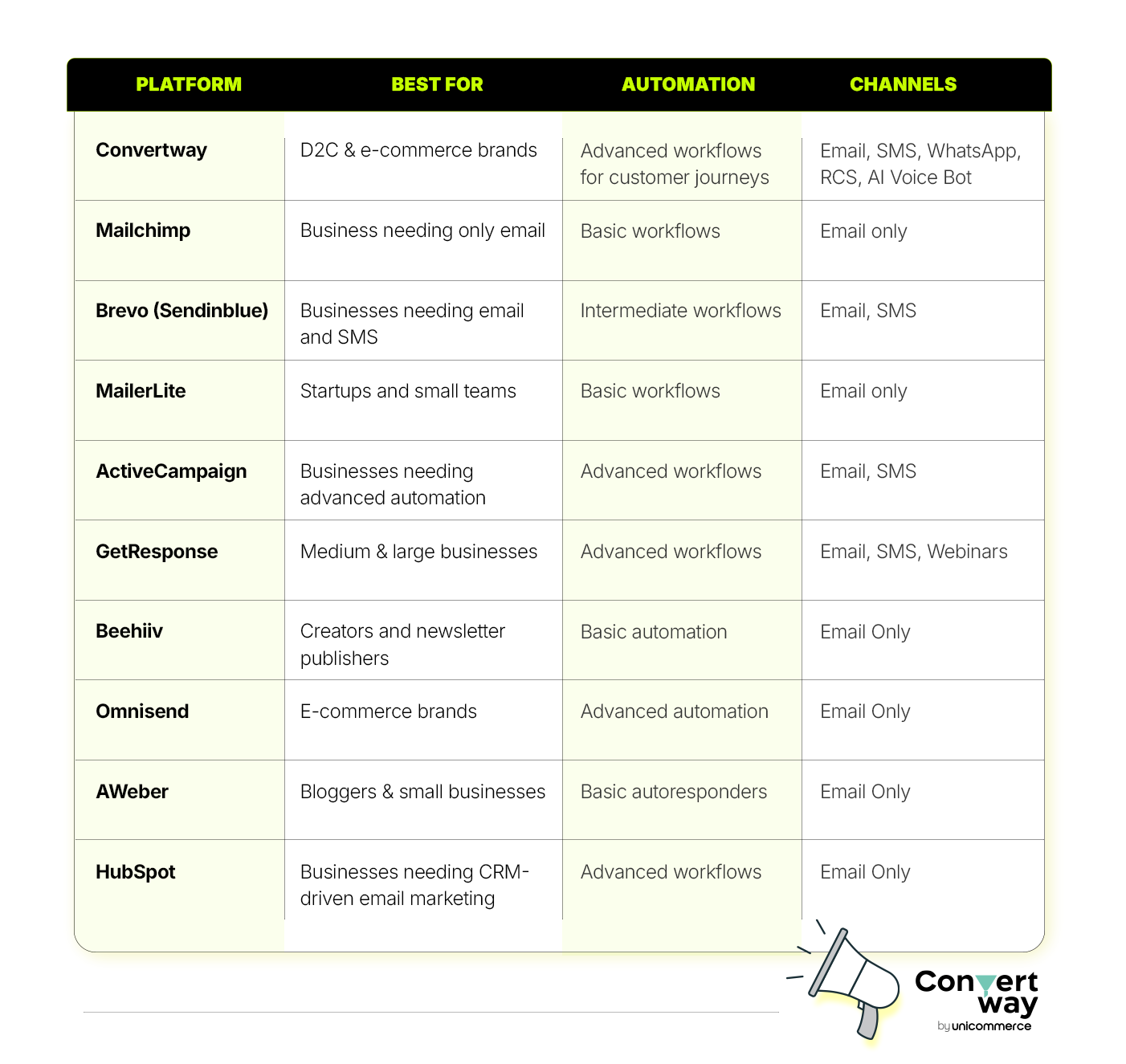
Now that you know the pros and cons of each platform, the next step is figuring out which one works best for your business. While many tools offer similar features, the right choice usually depends on your business size, marketing goals, budget, and automation needs.
Here’s how you can choose the best:
Small businesses often prioritize simplicity and affordability when evaluating email platforms. They typically look for easy campaign creation, templates, and basic automation.
Larger businesses or fast-growing brands often need more advanced features such as deeper segmentation, multi-channel communication, and detailed analytics. These capabilities become important as customer databases and campaign complexity increase.
Think about what you want to achieve with email marketing. If you mainly send newsletters or basic promotions, a simple platform can do the job.
But if your plan includes automated journeys, lifecycle campaigns, and personalized messaging, you’ll need a tool with stronger automation.
Budget is another important factor. Many platforms offer free plans, which are great for startups testing email campaigns.
As your business grows, paid plans usually unlock better automation, segmentation, and analytics to improve results.
Automation is where modern email platforms really shine. Look for tools that support behavior-based triggers, automated sequences, and customer journey workflows so the right message reaches customers at the right time.
Finally, check how well the platform connects with your existing tools. Good integrations with CRM systems, e-commerce platforms, analytics tools, and support software help keep customer data organized and campaigns running smoothly.
Email marketing continues to be one of the most reliable digital marketing channels for businesses of all sizes. But the real impact often depends on choosing the right platform to manage your campaigns, engage customers, and drive conversions.
Today, there are plenty of email marketing tools available, each offering different features, automation capabilities, and pricing models. Some platforms are great for beginners who want to run simple campaigns, while others are built for growing brands that need advanced automation, deeper segmentation, and multi-channel communication.
In the end, the best platform is the one that aligns with your business size, marketing goals, budget, and automation needs. Taking the time to compare these factors will help you choose a tool that not only supports your current campaigns but also grows with your business over time.
FAQs
What is the best email marketing software for businesses?
The best email marketing software depends on your business needs, audience size, and marketing goals. Some platforms focus on ease of use for beginners, while others offer advanced automation, segmentation, and multi-channel communication for growing brands.
Are there free email marketing platforms available?
Yes, several email platforms offer free plans with basic features. These plans usually include limited contact and sending volumes, making them suitable for small businesses and startups testing email campaigns.
Which email marketing tool offers the best automation features?
Many modern email marketing tools provide automation features such as triggered emails, customer journey workflows, and behavior-based messaging. Businesses that rely heavily on automated communication should look for platforms with advanced workflow capabilities.
How do businesses compare email marketing platforms?
Businesses typically compare email platforms based on features, automation capabilities, integrations, pricing, and ease of use. Looking at these factors together helps determine which solution aligns best with marketing strategies.
What features should businesses look for in an email marketing platform?
Important features include automation workflows, audience segmentation, analytics and reporting, templates, and integrations with other business tools. Platforms that support multi-channel communication can also provide additional value for growing brands.