Somewhere right now, a D2C brand is losing a customer.
Not because their product is bad. Not because their price is wrong. But because their competitor responded faster, personalised better, and reached the customer at the right time, while the first brand was still figuring out which AI tools to use.
That's the real cost of a broken marketing stack in 2026. Not just wasted hours, Lost revenue. Lost customers. Lost ground that quietly compounds every single week.
And the painful part? The tools to fix this exist. Most brands just haven't built the right stack yet.
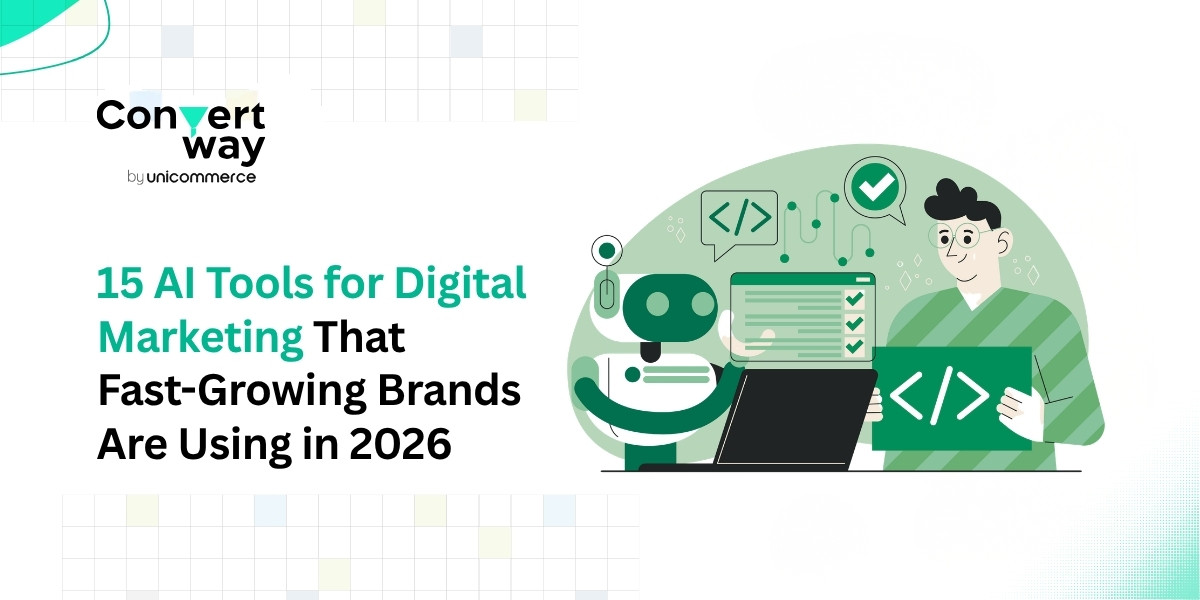
So here's a straight-up breakdown of the best 15 AI tools for digital marketing that are actually worth adopting, tested, practical, and ordered in a way that makes sense to implement.
You’re right, “AI marketing tools” sounds broad, but most brands see real results when they start with the right approach. Instead of trying to do everything at once, it helps to break it down into a few clear areas where AI actually creates impact.
In marketing, it really comes down to these simple things:
AI takes over routine tasks, content drafting, emails, campaign setup, and reporting, so your team can focus on thinking, not doing.
Instead of static segments, AI adjusts messaging based on real-time behavior and what people browse, click, or ignore.
AI helps you identify who is likely to convert, drop off, or become a high-value customer so you can act early.
From blogs to ads to product descriptions, AI generates content quickly, making it easier to scale and test different ideas.
This isn't about hype. There are five concrete reasons why the gap between brands that use AI well and those still figuring it out is widening every month.
Customers today know what good experiences look like, and that sets a higher bar for every brand. With AI, it becomes easier to deliver timely, relevant communication that actually matches what your customers are looking for.
Speed is about staying relevant. AI helps you move more quickly across content, campaigns, and decisions so you can respond when it matters most, not after the moment has passed.
People are now exploring and discovering through platforms like ChatGPT, Perplexity AI, and Google AI Overviews. This creates a chance for your brand to show up in more meaningful ways, as long as your content is clear and helpful.
You already have valuable data across your business. AI helps you make better sense of it by turning raw information into clear insights you can actually act on, without slowing your team down.
Brands that are actively using AI are seeing improvements in speed, efficiency, and overall performance. Starting now puts you in a strong position to grow while others are still figuring it out.
The 2026 opportunity isn't about adding more tools to that pile. It's about replacing the chaos with a connected, intelligent stack that actually talks to itself, one that saves time, reduces cost, and compounds results. For marketers looking to discover more AI-powered solutions beyond individual tools, ToolBees provides a directory to explore AI tools across different categories and use cases.
So, here’s the best 15 AI tool for digital marketing that actually makes your work easier:
Most AI writing tools generate text. Claude generates thinking.
What it handles:
Real example: A D2C brand briefed a full month's content calendar, three blog outlines, and five email subject line variations in one sitting. What used to take two days now takes a morning.
What it handles:
Real example: A D2C fashion brand's marketing lead runs her entire content operation in Notion with no dedicated project manager. Reports that used to take two hours now generate on their own.
Most SEO strategies are built on gut feel and hope. Semrush replaces both with data.
Key features:
Real example: The team relied on guesswork for SEO, often creating content that didn’t rank. With Semrush, they identify real search gaps and build content that starts gaining traction within weeks.
Design bottlenecks often slow down campaigns more than expected, especially when every small request depends on a designer.
Best for:
Real example: D2C skincare brand of Skincare, cut social asset turnaround from five days to same-day after switching to Canva.
Landing pages and UI ideas often get stuck in long feedback loops before execution.
Best for:
Real Example: A brand, instead of delaying launches for final design approvals, builds and finalizes landing page layouts in a single review cycle.
Every strong blog or campaign starts with solid research. The problem with most tools is that they make up sources. Perplexity doesn't.
Why it stands out:
Best use: Run a 10-minute Perplexity sprint before any brief. It's the difference between content that sounds relevant and content that actually is.
For large teams producing templated marketing copy at scale, Jasper earns its place.
How it works best:
Real Example: A brand, instead of struggling with volume, keeps content production consistent without overloading the team.
Tools sitting in isolation are only half the value. The automation bridges between them are where the real leverage lives.
What it enables:
Zero manual handoffs. No dropped balls. Teams running connected automation like this save an average of six hours per person per week without touching a single line of code.
Running 40 ad variations for a seasonal campaign used to mean a photoshoot, a design retainer, and two weeks of feedback cycles. Now it means a prompt and two days.
Real example: One D2C activewear brand generated, tested, and launched a full seasonal creative suite in 48 hours. Their competitor was still briefing a photographer.
Surfer scores content in real-time before it goes live. Every gap, semantic, structural, or competitive, shows up before publication rather than after.
Best workflow:
No post-publish scrambling. No wondering why a piece isn't moving.
Meetings often generate valuable ideas, decisions, and action points, but manually capturing everything can slow teams down. Krisp helps businesses make meetings more productive with AI-powered features like noise cancellation, meeting transcription, and AI-generated notes. It allows teams to focus on conversations while automatically capturing important details, summaries, and follow-up tasks.
Krisp helps teams:
Remove background noise and distractions during calls
Generate accurate meeting transcripts automatically
Create AI-powered meeting notes and summaries
Keep important discussions organized and easy to revisit
For remote teams, sales professionals, and marketers, Krisp reduces the time spent reviewing meetings and ensures that important insights are never lost. By turning conversations into actionable information, it helps teams communicate more efficiently and stay aligned.
Here's a problem every growing marketing team hits: the brand sounds different depending on who wrote it. Grammarly fixes that.
What it does in 2026:
Best workflow pairing: Claude drafts, Grammarly governs. Together, they cut editing cycles by around 70%.
Getting started is often the hardest part.
Best for:
Real Example:
A brand, instead of spending hours brainstorming, generates multiple directions and moves forward quickly.
For creators and businesses producing realistic talking videos at scale, Magichour's lip sync video AI technology is a standout choice.
How it works best:
Real Example: A marketing team can quickly localize promotional videos for different regions by generating accurate lip-synced versions in multiple languages, eliminating the need to re-record or manually edit each video.
Here's the gap in most marketing stacks: content creation gets sorted brilliantly. Customer communication stays completely fragmented.
What Convertway covers:
Real example: D2C sportswear brand Zeno Active built a single Convertway flow for cart abandonment:
Fully automated. Zero manual touchpoints.
Good strategy comes first. AI marketing tools accelerate it, but they don't replace it. A weak strategy running on great tools just fails faster. Get the thinking right first, then let the tools do their job.
The brands pulling ahead in 2026 aren't the ones with the biggest teams or the fattest budgets. They're the ones who stopped doing manually what a tool can handle better.
Every week that gap stays unaddressed, it gets a little harder to close.
FAQs:
1. Which AI tool is best for digital marketing?
There isn’t one single best tool. It depends on what you’re trying to solve. For content, tools like Claude or ChatGPT work well. For SEO, Semrush or Surfer SEO are more useful. For WhatsApp, AI voice agents, chatbots, and customer communication, Convertway is a strong choice. The right approach is to pick tools based on your biggest bottleneck.
2. What are the best AI tools for digital marketing in 2026?
The best AI tools in 2026 are the ones that help across content, SEO, design, automation, and communication. This includes tools like Canva, Notion, Zapier, and Convertway that make everyday marketing faster and more efficient
3. How do I choose the right AI marketing tool?
Start by identifying where your team is losing the most time, whether it’s content, design, SEO, or communication. Then pick one tool that solves that problem instead of trying to adopt everything at once. Once that’s working, you can expand your stack step by step.
4. What is the biggest benefit of using AI tools in marketing?
The biggest benefit is speed combined with better decision-making, as AI helps teams execute faster while also improving targeting, personalization, and insights
5. Do AI marketing tools help with SEO?
Yes, AI tools help with SEO by identifying keyword opportunities, optimizing content before publishing, and aligning it with actual search intent rather than guesswork.
6. What is an AI voice agent in marketing?
An AI voice agent is an automated system that can call customers, confirm orders, follow up, or recover drop-offs without requiring a human agent.
7. What mistakes should I avoid when using AI marketing tools?
Avoid using too many tools at once, relying on AI without a clear strategy, and not integrating tools properly, as this can create more confusion instead of efficiency.