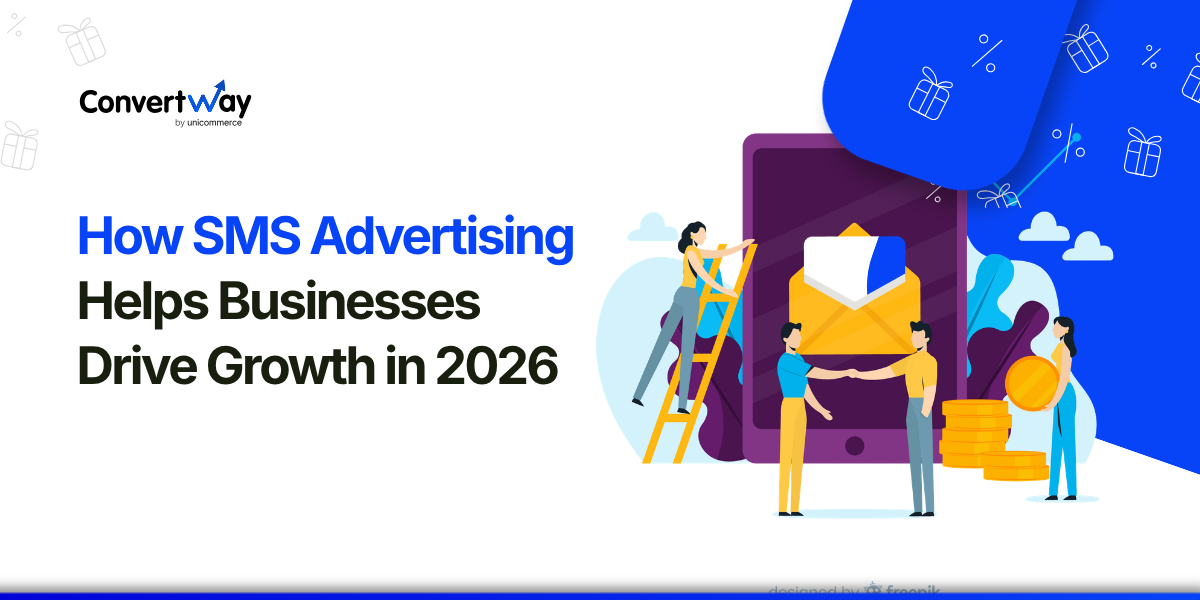
Every person checks their phone around 150 times a day, and that's a fact. When they're not, they're probably scrolling through Instagram Reels or YouTube Shorts. Any notification that appears during that moment is likely to be clicked out of sheer reflex. Hence, SMS marketing is the most effective growth lever in 2026 for growing brands.
According to research, SMS messages have a 98% open rate, and 90% of text messages are read within three minutes of delivery. If you compare this with other platforms like email, the engagement rates are significantly higher.
But here's the thing: most brands are still treating SMS advertising like a mass broadcast tool. They're sending the same text to every contact on their list, at the same time, with no segmentation and no strategy. And then they're wondering why their opt-out rates are climbing.
So, this blog is about doing it differently. For that, we'll cover what SMS advertising actually is, why it works, and the exact steps to run campaigns that drive real revenue in 2026, with examples you can use right now.
SMS advertising still works in 2026 because:
SMS is a space where your customers are active. They respond to their family and friends and check their delivery updates there as well. When your brand shows up in that space, it receives a different kind of attention.
Push notifications only work if someone has downloaded your app. SMS advertising reaches every mobile number, regardless of what apps your customers use. That's a meaningful distribution advantage.
Research shows that SMS advertising outperforms in-app and in-game ads when it comes to driving immediate purchase intent. And, because the cost per send is relatively low compared to paid social, even a small increase in conversions can have a noticeable impact on your margins, especially if you're a D2C brand operating on thin margins.
People don't mind receiving text messages from brands when they're relevant and useful. What they dislike are random promotions, offers landing in their inbox at odd hours, and messages that clearly weren't meant for them.
Now that we know why SMS still works, here's the practical part: how to use SMS marketing to grow your business and make sure your messages don't end up sounding like every other promotional text.
After years of experience working with growing businesses, we've found a few approaches that can actually make your messages stand out and feel more engaging. Here are some of them:
It's Thursday night, you've got excess stock on a particular category that needs clearing before the new stock comes in, and you only have 48 hours to do it. And then comes the text message marketing for business. A short 160-character message sent to the right segment with a real deadline and a working link.
What a high-converting flash sale SMS looks like:
“Hi Priya! Get 30% off our Midnight Collection - today only. Shop before midnight: [link] Reply STOP to opt out.” No other information is necessary here, just brand signal, deal, deadline, link, and opt-out.
How to set it up:
Most brands announce a new product and directly send the message with a selling offer. The brands that convert better do something slightly different. They create a two-step sequence that builds anticipation before the product comes to market. Like, they send a teaser SMS that feels like a tip from someone who knows something you don't.
Message 1: Two days before launch:
“Something new from [Brand Name] drops this Thursday. You're hearing about it first. Stay tuned.”
Message 2: Launch day:
“It's live. [Product Name] is now available. Exclusively for our SMS subscribers before we go wide. Get yours: [link].”
Customers who feel like they get first access before the general public help the brand to convert at meaningfully higher rates than customers who see the same offer after it's been announced to everyone.
Cart abandonment sits at around 70% across ecommerce. SMS advertising closes that gap. A text arrives within seconds and gets read within minutes, which helps when customers leave any product in their cart. Like, a customer who walked away from their cart 20 minutes ago is still in the decision window. Your job is to show up before that window closes.
What an effective abandoned cart text looks like:
“Hey Rohan, you left something behind. Your Noise ColorFit Pro is still in your cart. Grab it before it sells out: [link].”
Notice what's doing the work here: the customer's name, the specific product name, and a genuine low-stock signal. These three elements together make this feel personal.
How to set it up:
Festivals, sports seasons, and end-of-year sales are moments when your customers are already in a spending mindset. Your job is simply to show up with the right offer at the right time to convert them.
And this is where bulk SMS advertising really helps. During Diwali, brands like Myntra often use curated SMS campaigns based on what customers have browsed or purchased. During the IPL season, fantasy apps use text advertising to bring dormant users back with match-day reminders. The messages work because they are on time when the customer is free, have a relevant message, and tap into what customers are already thinking about.
Here's how a 3-day Diwali bulk SMS advertising sequence can look for your brand:
Day 1: Three days before Diwali:
Diwali is 3 days away! And our best deals just dropped. Explore now: [link]
Day 2: One day before:
Last 24 hours! Up to 40% off on [Category]. Orders placed today arrive before Diwali: [link]
Day 3: Diwali morning:
Happy Diwali from [Brand]! 🎆 Your gift to yourself: 20% off site-wide, today only. [link]
These are three messages with three different urgency angles, but they don’t feel like spam because every message has a fresh reason to exist.
Winning back an existing customer is usually far less expensive than acquiring a new one. And just because someone hasn't purchased from you in the last 4–6 months means they just don’t have any reason to come back. Text advertising is one of the most effective re-engagement tools for exactly this use case.
What a win-back SMS needs to feel like:
Hi Ananya! It's been a while. Here's 15% off just for you. No minimum order required. Valid for the next 48 hours: [link]
How to set it up:
By now, you know where SMS advertising fits into your growth strategy. But knowing when to send a message and what to say is just as important as sending it in the first place. Let's get into that next.
Think about it. Your customer sees dozens of notifications every day. If your message looks like every other promotional text they've received, they're going to ignore it without a second thought. So, what makes someone stop scrolling, open the message, and actually click?
So, here are some ways to make your business text messages actually get read:
Most brands start with their name and then start the message with the offer directly, but customers think the opposite way. For instance, "Myntra New arrivals now available" doesn't tell customers why they should care. But "50% off Nike sneakers - today only" immediately gives them a reason to pay attention.
Customers don't want to decode marketing messages. If you're offering a discount, say exactly what it is. "Big savings inside" sounds vague. "Get ₹500 off on orders above ₹2,000" tells customers exactly what they're getting and helps them make a decision quickly.
Research shows that over-sending is the top reason people opt out. If you are sending more than 4–6 promotional texts per month, and you start losing subscribers faster than you're adding them. So, do not send the message again and again.
This might sound counterintuitive, but customers trust brands more when they know they have a choice. Including an opt-out option shows respect for your customers and gives them confidence that they're in control of the conversation.
So, at the end of the day, customers ignore those messages that are not relevant, useful, or sent in odd hours. Get those three things right, and your chances of getting opened, clicked, and remembered go up significantly.
Now, all of this sounds great in theory. But manually segmenting customers, personalizing messages, scheduling campaigns, and keeping track of compliance standards can quickly become overwhelming as your business grows. That's where having the right tool makes all the difference.
And that's exactly what Convertway helps you with. Instead of just sending bulk texts, it helps you create smarter SMS campaigns with automation, personalization, and the features you need to turn SMS advertising into a real growth channel. So, let's take a look at the features Convertway brings to the table.
Convertw's SMS platform is built around the way ecommerce brands actually operate, like handling multiple customer segments, multiple campaigns, and sending a message that goes with customer intent and what they are searching for to convert them from performance to revenue. It has everything a brand needs to manage its ongoing campaigns, from launching a campaign.
Here's how ConvertWay helps:
If you're ready to move from occasional one-off texts to a structured SMS advertising system, Convertway gives you the tools to create, automate, personalize, and measure SMS advertising that contributes to business growth.
SMS advertising works because it reaches customers where they already are on their phones, and in a channel they actually check.
But the difference between brands that grow with it and brands that frustrate their customers with it comes down to one thing: treating every text like a conversation. Segment the right audience, write a message worth reading, pick the right moment to send it, and measure what actually drives revenue.
The brands doing all of that in 2026 are just sending smarter ones. Want to understand what's actually driving results in your SMS campaigns? Read our guide on SMS campaign metrics for ecommerce, which covers the exact numbers to track and what each one is telling you.
FAQs:
1. What is SMS advertising?
SMS advertising is the practice of sending promotional text messages to customers to drive actions such as purchases, website visits, product launches, or event registrations. Unlike email, SMS reaches customers directly on their mobile phones and often generates higher engagement rates.
2. How do businesses use text message advertising?
Businesses use text message advertising for flash sales, abandoned cart recovery, new product launches, seasonal campaigns, customer re-engagement, and limited-time offers.
3. What is bulk SMS advertising?
Bulk SMS advertising refers to sending promotional messages to a large group of subscribers at once. Modern bulk SMS campaigns use segmentation so different audiences receive messages that are relevant to them.
4. What is the best time to send SMS advertising campaigns?
Many businesses find that SMS campaigns perform best between 12 - 2 PM and 6 - 9 PM, when customers are more likely to check their phones.
5. How can businesses measure the success of SMS advertising campaigns?
Key metrics include delivery rate, click-through rate, conversion rate, revenue generated, and unsubscribe rate.
6. Which types of businesses benefit most from SMS advertising?
Ecommerce brands, retailers, restaurants, beauty businesses, healthcare providers, and service-based businesses often see strong results from well-executed SMS campaigns.