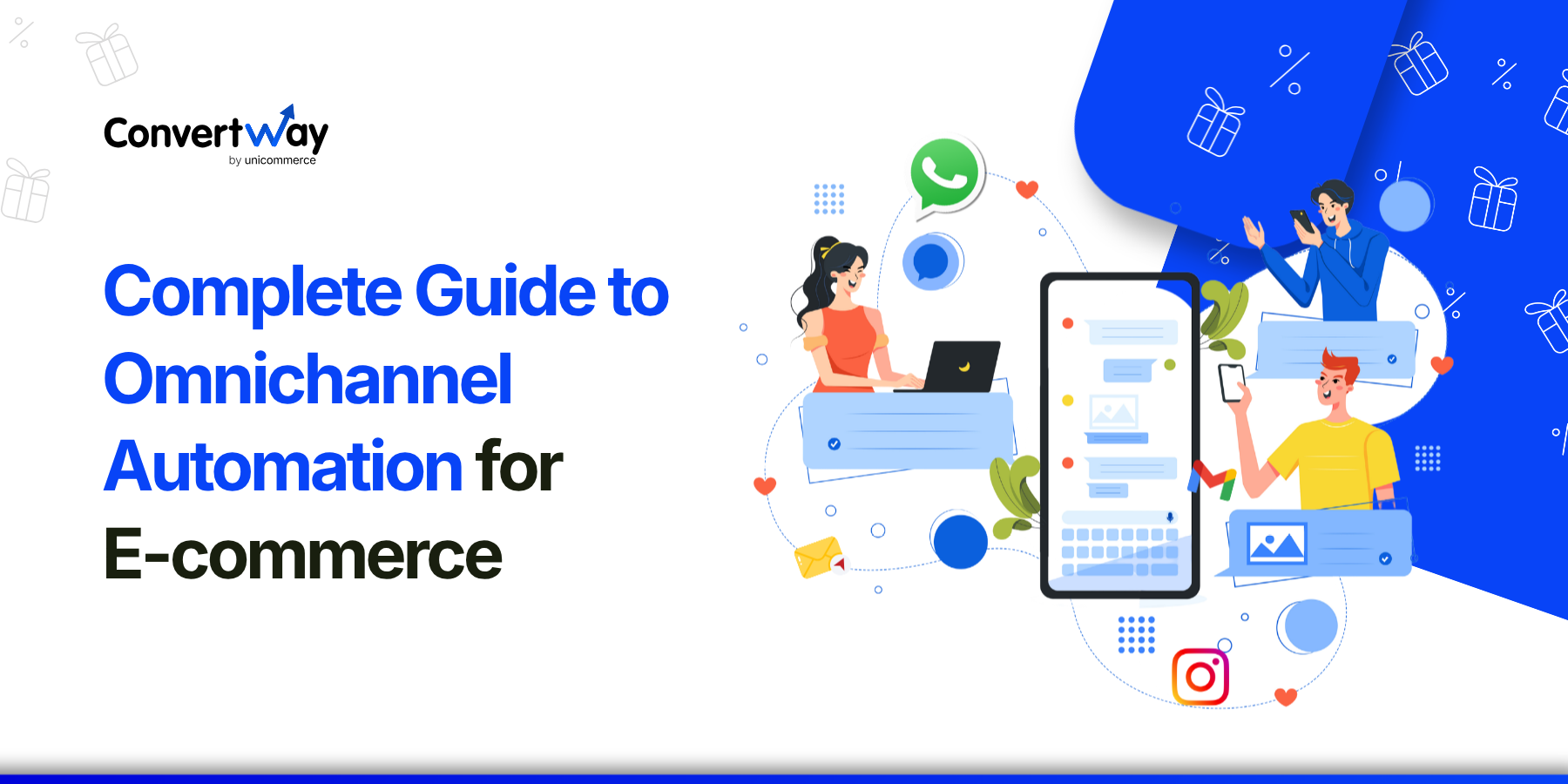
Most e-commerce brands today are everywhere, spreading themselves across email, SMS, WhatsApp, and push notifications. On paper, that sounds like omnichannel. But in reality, these channels often work in silos, leading to delayed messages, inconsistent communication, and missed opportunities.
That’s where omnichannel automation changes the game.
Instead of manually managing campaigns across platforms, automation connects your channels and responds to customer behavior in real time, such as sending the right message, on the right channel, at the right moment.
In this guide, we’ll break down what omnichannel automation really means for e-commerce brands, how it works behind the scenes, and how you can start building high-impact automated journeys without overcomplicating your stack.
Here is the simplest way to think about it. Omnichannel automation is not about being everywhere at once. It is about making every channel your brand uses work together, automatically, based on what a customer actually does.
A customer visits your Shopify store, browses a moisturizer, adds it to the cart, and leaves. An hour later, a WhatsApp message lands with the exact product they were looking at. The next morning, if they still have not purchased, an SMS goes out with a small discount. Once they buy, an email follows with usage tips and a cross-sell. No manual effort is needed.
That is the power of omnichannel automation in practice, and for eCommerce brands competing in 2025, it is no longer optional.
Today's shopper does not live on one screen. They discover on Instagram, compare on Google, buy on mobile, and expect support on WhatsApp, sometimes within the same hour. Research from McKinsey shows that 75% of consumers now use at least three channels in a single buying journey.
Yet most brands are still running campaigns manually. Someone drafts a message, schedules it, and hopes for the best. No real-time triggers, no personalization, no coordination between channels. Customers feel the disconnect immediately.
The business case for fixing this is clear. Marketing automation delivers a return of $5.44 per dollar spent over three years, with 76% of companies seeing positive ROI within 12 months. When you cannot re-engage customers automatically, every rupee spent acquiring them is a one-time bet with no compounding return.
E-commerce omnichannel strategy changes this entirely. It turns customer behavior into triggers, triggers into workflows, and workflows into consistent, scalable revenue without your team lifting a finger each time.
Most brands start with good intentions. Email goes live. SMS is added. A WhatsApp Business account gets created. Then the cracks appear. None of these tools talk to each other.
A customer buys but keeps getting abandoned cart messages because the SMS tool did not sync with the order system. A VIP customer receives the same generic discount as a first-time visitor. Someone unsubscribes from email but continues receiving WhatsApp blasts. The result is irrelevant, poorly timed messaging that erodes trust instead of building it.
The numbers make this painful to ignore. Companies with strong omnichannel engagement retain 89% of their customers, compared to just 33% for brands with weak or disconnected strategies. That 56-point gap is not a marketing gap. It is a systems gap. And disconnected tools are almost always the root cause.
The logic is straightforward: Trigger → Workflow → Channel → Message → Optimization.
A trigger is any customer action or inaction - visiting a product page, abandoning a cart, completing a purchase, or going quiet for 30 days. The trigger fires a workflow, a pre-built sequence of steps. The workflow decides which channel to use based on what is most likely to get a response. The message is personalized based on what the customer actually did. Optimization happens continuously as the system learns.
Here is a real-world example of omnichannel marketing automation in action for a skincare brand:
Customer browses a face serum but does not add it to the cart. After 2 hours, a WhatsApp message with the product image and a soft nudge. After 24 hours with no purchase, SMS with a 10% discount code. After purchase: an email with a usage guide and a complementary product suggestion. After 15 days: WhatsApp check-in asking for a review.
Every step is automated. Every message is relevant. Every channel is chosen with intent. This is orchestration, not broadcasting.
Not all workflows deliver equal returns. When starting out, focus on the journeys with the clearest triggers and the highest revenue impact.
This is non-negotiable. The global average cart abandonment rate is 70.19%, meaning fewer than 3 in 10 shoppers actually complete checkout. For eCommerce brands, this is the single biggest recoverable revenue opportunity. Automated messages sent via WhatsApp can recover up to 60% of abandoned carts when timed and personalized correctly. Start here. Always.
It targets customers who showed intent but never reached the cart. A personalized WhatsApp message featuring the exact product they viewed re-engages high-intent visitors before a competitor does.
This is where most brands go completely silent and where long-term value is built or lost. An automated sequence covering order confirmation, delivery updates, usage tips, and a timely review request keeps the relationship warm and sets up the next purchase naturally.
It targets customers who have gone quiet for 30, 60, or 90 days. A well-timed SMS or WhatsApp message with a personalized offer can reactivate a segment that would otherwise churn for good.
Channel selection is about context, not preference. Each channel plays a specific role and using the right one at the right moment is what makes omnichannel automation feel helpful rather than intrusive.
Email works best for depth. Post-purchase sequences, product education, loyalty rewards, and long-form storytelling all belong here. Customers engage on their own terms.
This is built for urgency. Flash sales, last-chance reminders, and cart recovery nudges perform exceptionally well. With up to 98% open rates, it is the most reliable channel for messages that absolutely need to be seen.
WhatsApp is where engagement and interaction happen. With an average 60% click-through rate, it is ideal for abandoned cart recovery, personalized recommendations, review requests, and two-way conversations. In India, especially, WhatsApp is where your customers already live.
These are for real-time nudges. Back-in-stock alerts, flash deal announcements, and order updates work best here for customers who have opted in through your app.
The key rule: Do not fire all channels at once for the same message. Sequence them intelligently and let engagement signals guide escalation.
When e-commerce omnichannel automation is done well, the compounding impact on business performance is hard to overstate.
Omnichannel strategies increase purchase rates by 287% compared to single-channel approaches, and customers who engage across multiple channels carry a 30% higher lifetime value. Beyond numbers, the customer experience improves because messages feel relevant and timely rather than random and spammy. That feeling drives loyalty far more effectively than any discount ever will.
Operationally, your team stops firefighting and starts strategizing. Automated workflows run around the clock. Cross-channel communication stays consistent, which means your brand sounds the same whether a customer hears from you on SMS, WhatsApp, or email. And consistency, as every retention-focused brand knows, is the foundation of trust.
FAQs
1. What is the difference between multichannel and omnichannel automation?
Multichannel means being present on multiple platforms independently — email, SMS, WhatsApp, each doing their own thing. Omnichannel automation means all those channels share data and respond to the same customer behavior in a coordinated way. The difference in outcome is significant. Brands with strong omnichannel strategies retain 89% of customers versus 33% for those with disconnected approaches.
2. Which automation flow should an eCommerce brand build first?
Abandoned cart recovery, without question. The trigger is clear, the customer intent is already there, and the ROI is immediate. Start with a two to three-step sequence across WhatsApp and SMS, then expand to browse abandonment and post-purchase flows once the first one is live and optimized.
3. How many messages are too many in an automated sequence?
Two to three touchpoints per journey, spaced 12 to 24 hours apart, is a healthy starting point. Watch unsubscribe rates closely after each touchpoint. If they spike after a specific message, that is a direct signal to reduce frequency or rethink the content at that stage.
4. Can small eCommerce brands benefit from omnichannel automation?
Absolutely, and they arguably benefit the most. Automation levels the playing field. You do not need a large marketing team to run personalized, behavior-driven journeys. Platforms like ConvertWay are designed specifically for growing Shopify brands with simple setup, pre-built flows, and pricing that scales with your order volume.