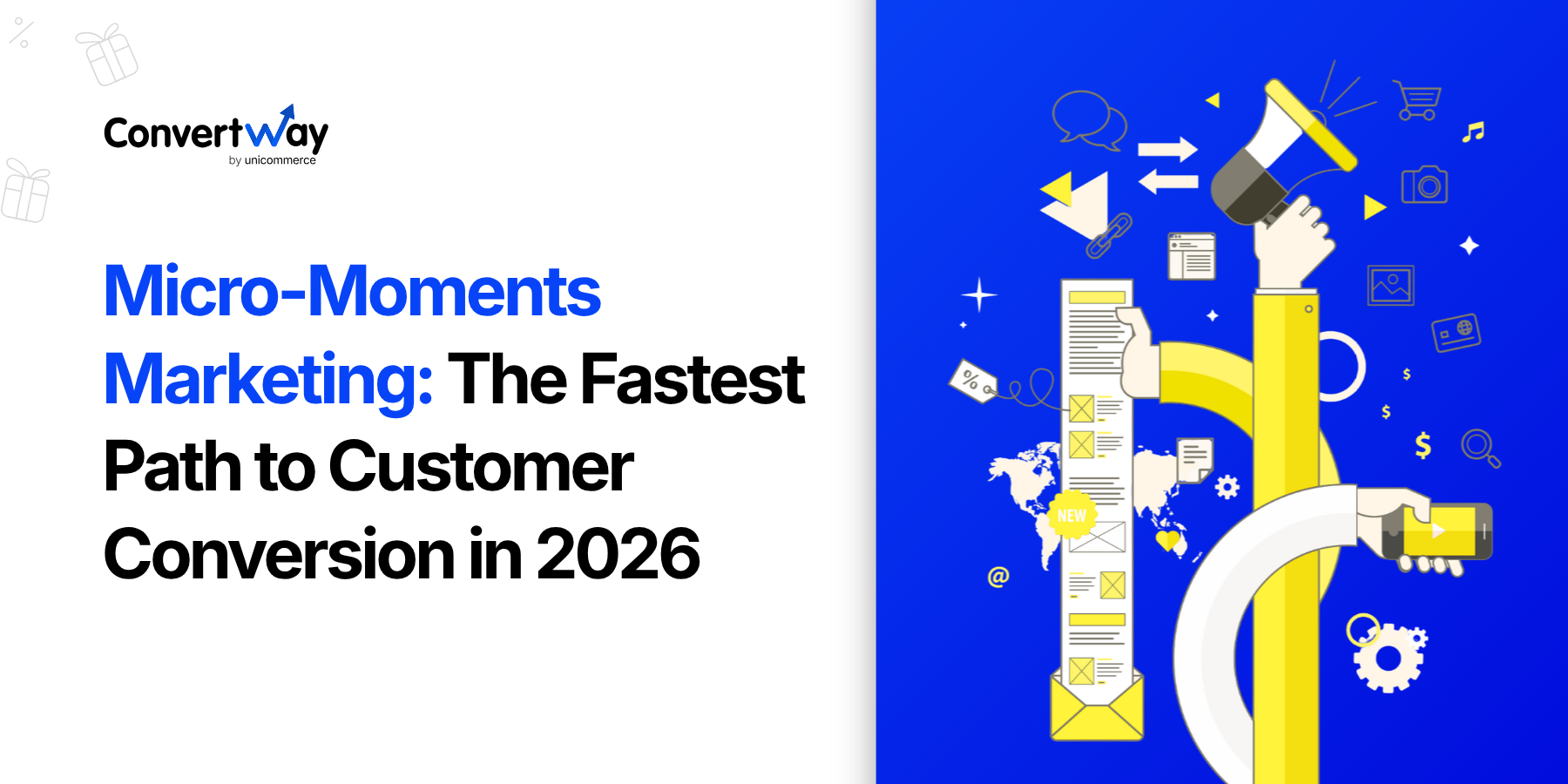
Micro-moments are quietly becoming the biggest growth driver for modern brands, and the ones who understand them are winning customers before their competitors even realize what happened.
Think about it: A customer searched “best sports shoes for running” at 11:45 PM on their phone, clicked an ad by 11:48, landed on the page, scrolled through the website, and then left, and now they are probably on a competitor’s page.
That 90-second window is a micro moment or intent-based marketing, and most brands miss it while sleeping because their customer journey optimization has not caught up with their channels, and gets captured by competitors.
But here’s the thing: you probably don’t know how to capture it. So this blog is for you. In this, we will explain everything about micro-moment marketing and how to capture that intent.
Micro moments marketing was coined by Google back in 2015, and it simply means capturing the split-second instances when customers search for any product to fulfill their immediate need.
It refers to high-intent situations where:
There are four micro-moment types worth knowing:
This is where the journey begins. The customer is exploring, reading comparisons, checking reviews, and watching videos. They’re not ready to buy yet, but they’re getting closer.
Show up here with genuinely useful content, and the brand recall alone is worth more than most paid campaigns. This is also where real-time marketing starts making its presence felt. The brand that surfaces first during research earns early trust.
Here, the intent is location-based. The customer is searching for something nearby or available quickly. This is crucial for brands with physical stores, local services, or same-day delivery, because visibility and convenience matter the most.
The customer is looking for help, tutorials, guides, or how-to content. They have intent, but not necessarily to purchase right away, and it’s your chance to build trust by being useful.
This is the trust-building window. Brands that show up with useful, practical content at this stage get consideration.
This is the most valuable moment as the customer has already done the research, compared options, and is ready to take action. Now, it all comes down to how easy, fast, and convincing your experience is. Because at this point, even a small delay can send them to a competitor.
Most brands already have the data, but they’re just not acting on it in time.
Signals like repeat product views, cart abandonment, or pricing page visits clearly show purchase intent. Each one is a customer saying, “I’m close, help me decide.”
But the problem is speed. Brands respond in 6–24 hours, while customers decide in under 2 hours. That gap is where conversions are lost.
In today’s fast-moving digital consumer behavior, the journey isn’t linear. Customers jump between platforms, and the brand that responds first to their intent wins.
This is where it gets practical.
Understand this with a simple example: Scheduled emails don’t capture micro-moments. If you’re sending emails based on time, they won’t work when the intent doesn’t match. Your email may go out on Tuesday, but the customer shows interest at 12:50 AM on Saturday.
That’s a missed micro moment.
Conversational marketing works differently. It’s two-way, real-time communication triggered by what a customer just did, not when a calendar says to send something.
It works like:
The shift is simple but powerful.
This is where intent-based marketing changes everything. Now you can react to customer signals to engage at the exact moment that matters.
There are multiple channels available, and using the wrong one at the right moment is almost as costly as not responding at all. A customer in a "I want to buy" moment doesn't want a newsletter. A customer mid-research doesn't need a sales call.
So here's a breakdown of every channel, what it's actually good for, and when to fire it:
98% open rate and average response time is under 90 seconds. It supports rich media, product carousels, and two-way conversation, the closest digital experience to an actual in-store conversation. This is the frontline channel for real-time marketing at the moment of peak intent.
Best for:
No internet needed. No app install required. Zero friction on the customer's end. 90% of SMS messages are read within 3 minutes of delivery, making it one of the most reliably seen channels in any micro-moment marketing strategy. It doesn't need to be rich. It just needs to arrive and be read.
Best for:
Email has just been used incorrectly as a first-response channel. Repositioned correctly, it handles depth, detailed comparisons, post-purchase education, and long-form social proof. The content that doesn't fit in a WhatsApp message but absolutely influences the final decision.
Best for:
Social media is where micro-moments start, not where they finish. A customer watches a Reel, sees a product in use, and reads a comment from a buyer. That's intent forming in real time. Treat it as a signal layer, then follow up on a direct channel fast.
Best for:
The highest-touch automated channel available, and still the most underused. For high-consideration purchases, a voice call does something no text channel can: it sounds human. This is conversational marketing at its most powerful form. An AI voice agent calling within 15 minutes of a high-intent signal consistently outperforms every text-based follow-up.
Best for:
The most immediate channel for customers who already have the app, and the most ignored when used generically. A generic "check new arrivals" notification does nothing. One that fires because a customer just viewed a product three times and the price just dropped, that converts.
Best for:
The brands doing this well didn't build something complicated. They built something consistent. Four steps, that's it.
Every brand’s data is already telling the story. The key is to identify behaviors that consistently show up right before a purchase happens. These are your strongest intent signals and the foundation of your micro-moment strategy.
Focus on patterns like:
Once a signal is identified, the next step is responding through the right channel. The goal is not convenience, but relevance. This is the core of customer journey optimization, matching the message channel to the exact type of intent the customer just expressed.
For example:
Even with the right trigger and channel, most brands still miss the moment because of poor messaging. Generic promotions don’t work in micro-moments because they ignore context.
Here’s the difference:
The difference is clear. One feels like a broadcast. The other feels like a response. And that difference directly impacts conversions.
A micro-moment system only works when every step has a defined next step. Proper customer journey optimization means no intent signal ever falls into silence.
For instance, once a WhatsApp message is sent, if the customer does not respond within 2 hours, an SMS should automatically follow. If the SMS also gets no response after 24 hours, an email with detailed proof and a softer call to action should be sent. In cases where the product is high-value, and there is still no conversion, a voice agent can follow up on the second day.
This creates a continuous and connected journey where no high-intent moment is left unattended.
Five separate tools sound manageable, until triggers don't sync, channels overlap, and a ready-to-convert customer gets either the same message twice or nothing at all.
That's not a micro-moment system. That's a fragmented experience at the worst possible time.
Convertway fixes this by putting every channel inside one connected platform, including WhatsApp, SMS, RCS, Email, AI Chatbot, and AI Voice Agent, all triggered from the same signal, all aware of what the other channels have already done.
Here's how it works in practice:
Convertway tracks customer actions, product views, cart additions, repeat visits, and instantly turns them into triggers. No delay between the signal firing and the response going out. The brand shows up at the exact moment intent is highest, not an hour after it has expired.
Every channel lives inside one system. No overlaps, no delays, no disconnected experiences. WhatsApp fires first, SMS follows if needed, email catches the undecided, voice closes the hesitant, all coordinated automatically without manual intervention between steps.
Convertway uses live customer data to make every message feel relevant to that specific moment. Not a generic blast. Not a scheduled promotion. A message that reflects exactly what the customer just did, and what they're most likely thinking right now.
No signal falls into silence. If WhatsApp gets no response, SMS fires automatically. If SMS doesn't convert, email follows within 24 hours. The system keeps moving through the sequence without anyone on the team having to manually check what happened next.
Everything, every trigger, every response, every conversion, sits in one dashboard. Connects with existing CRM data so the team can track performance, spot drop-off points, and optimise journeys in real time without jumping between five different reporting tools.
The result: every micro-moment gets caught. Every intent signal gets a response. And no customer disappears because a tool handoff broke the sequence at the wrong time.
Micro-moments are happening every day, on every device, across every channel, at every hour. The brands winning in 2026 aren't the ones with the biggest budgets. They're the ones showing up at the right moment, on the right channel, with the right message.
The gap between intent and decision is under 2 hours, while most brands still respond in 24 hours. That’s where conversions are lost, and where your biggest opportunity lies.
Micro moments marketing isn't a campaign strategy. It's an always-on system built around digital consumer behavior, powered by real-time marketing, and executed through conversational marketing and intent-based marketing working in sequence.
The fix is simple: identify high-intent signals, respond on the right channel, and communicate with context. Then build a system that ensures no moment is missed.
Because in the end, it’s not about reaching more customers. It’s about showing up at the exact moment they’re ready, and that’s where Convertway fits in, handling the entire execution seamlessly so your brand never misses a high-intent moment.
FAQs:
1. What is micro-moments marketing?
Micro-moments marketing is the practice of identifying and responding to high-intent customer actions, like a product page visit, cart addition, or search query, in real time, across the right channel, before the decision window closes. The term was coined by Google in 2015 and has become central to how D2C and e-commerce brands approach real-time marketing today.
2. Why are micro-moments important for e-commerce brands?
Because customers don't wait. The average purchase decision window is under 2 hours, but most brands respond in 6 to 24 hours. Every hour of delay is a conversion handed to a competitor. Micro-moments marketing closes that gap by triggering the right communication the moment intent is detected, not hours later.
3. What are the four types of micro-moments?
Google defines four types:
4. What is the best channel for capturing micro-moments?
There's no single best channel. The right channel depends on the intent signal. WhatsApp works best for "I want to buy" moments with its 98% open rate. SMS is best for time-sensitive follow-ups. AI chatbots handle "I want to know" moments instantly. AI voice agents close high-value hesitation. The most effective approach uses all channels in a coordinated sequence.
5. What is intent-based marketing?
Intent-based marketing means using behavioral signals, page visits, searches, cart actions, and email opens to identify where a customer is in their decision journey, and responding with communication that matches that specific intent. It's the opposite of batch-and-blast. Every message is triggered by something the customer actually did.
6. How does Convertway help with micro-moment marketing?
Convertway brings every communication channel, including WhatsApp, SMS, RCS, Email, AI Chatbot, and AI Voice Agent, into one connected platform. When a behavioral trigger fires, Convertway responds instantly on the right channel, follows up automatically if there's no response, and coordinates the entire sequence without manual intervention. It ensures no micro-moment goes unresponded to and no customer falls through because of a disconnected tool setup.