Here's something every B2B marketer quietly knows: your buyer isn't going to see your email on a Tuesday morning and sign a contract by Friday afternoon. That's just not how B2B works.
B2B buyers' research. They compare. They loop in their finance team, their manager, and sometimes their manager's manager. They bookmark your website, forget about it, rediscover it three weeks later, and then consider reaching out.
And here, B2B email marketing helps. Unlike social posts or ads, emails land directly in front of your audience, letting you nurture leads, share value, and build trust. It's not flashy. But it works remarkably well.
So, in this blog, we’ll explore why B2B email marketing works, how it drives results, and how you can make it work for your business.
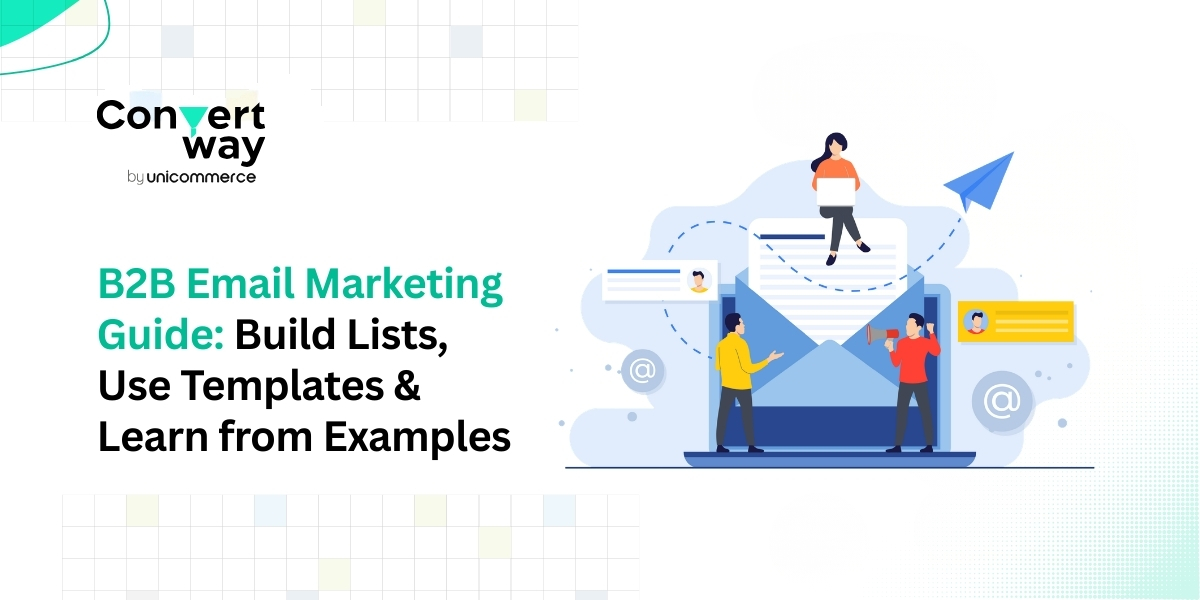
At its core, B2B email marketing is the practice of using email to communicate with other businesses, whether that's nurturing a lead, onboarding a new client, or staying in touch with existing customers.
But don't make the mistake of treating it like B2C email marketing with a button-up shirt on.
The differences are significant:
A consumer might buy a pair of sneakers on impulse. A business buying a SaaS tool or a logistics solution is going to take its time. Your emails need to support a much longer journey.
You're rarely talking to just one person. The email might go to a marketing manager, but the final decision could involve IT, finance, and the C-suite. Your messaging needs to speak to business value, not just personal appeal.
B2B buyers want information before they want a pitch. They want to understand the problem you solve, see proof that you've solved it for others, and feel confident that you know what you're talking about.
In B2B, relationships drive revenue. A single well-timed, well-written email can open a door that no paid ad ever could.
Let's be honest about something: a list of 500 highly qualified, genuinely interested contacts will outperform a list of 10,000 cold, unverified email addresses every single time. In B2B email lists, quality is a completely different game.
So how do you build a list that actually moves the needle?
Your website is your hardest-working salesperson. If someone's reading your blog, checking your pricing page, or downloading your resources, they're interested. A well-placed form, not intrusive, not annoying, can turn that visit into a lead.
This is one of the most effective strategies in B2B. Offer something genuinely valuable, an industry report, a how-to guide, a template pack, a webinar, and ask for an email in return. If your gated content disappoints, you'll lose the lead before you even have them.
If your content is good enough that people want more of it, a newsletter subscription is a natural next step. Don't underestimate this: a subscriber who opted in for your newsletter is far more engaged than someone whose card you picked up at a conference.
LinkedIn remains one of the best places to connect with decision-makers. Engage meaningfully in conversations, share useful content, and give people a reason to want to hear from you.
Whether in-person or virtual, events are excellent list-builders. The people who register for your webinar or attend your industry event are already signaling interest; that's a warm lead before you've even sent an email.
Your existing customer data is a goldmine. Past customers, churned accounts, and trial users who never converted already know who you are. Re-engaging them is often easier than acquiring new leads from scratch.
Templates exist for a very practical reason: reinventing the wheel every time you send a campaign is exhausting and inconsistent. Good B2B email marketing templates give you a reliable structure so you can focus your energy on the messaging, not the format.
Here are the key templates every B2B marketer should have in their toolkit:
When to use it: The moment someone signs up for your list, downloads a resource, or creates an account.
Why it matters: This is your first impression. Don't waste it on a generic "Thanks for signing up!" Set the tone, tell them what to expect, and give them something useful right away.
Subject: Welcome to [Company Name] - Here's where to start
Hi [First Name],
Thanks for joining us. Over the next few weeks, you'll hear from us about [what you deliver - insights, tips, product updates, etc.].
To get you started, here's something you might find useful: [link to your best resource, guide, or feature].
If you have questions or just want to chat, reply to this email. We're real people who actually read these.
[Your Name] [Company Name]
When to use it: Throughout your follow-up sequence, typically after a lead has shown interest but hasn't converted yet.
Why it matters: Most leads aren't ready to buy when they first engage with you. Nurturing keeps you top of mind and builds trust over time.
Subject: [Problem they care about]? Here's how others are solving it
Hi [First Name],
A lot of [job title/industry] professionals we speak with struggle with [specific challenge].
We recently worked with [Company Type] to [specific outcome achieved]. Here's a quick breakdown of how they did it: [link or 2-3 sentence summary]
If this resonates with something you're working through, I'd love to share more. Just hit reply.
[Your Name]
When to use it: When launching a new feature, product, or significant update.
Why it matters: Existing contacts already trust you. A well-timed product announcement reminds them of your value and can re-engage dormant leads.
Subject: New: [Feature/Product Name] is now live
Hi [First Name],
We just launched [Feature Name], and I think it's going to make a real difference for teams like yours.
Here's what it does: [2–3 lines explaining the benefit, not just the feature]
[CTA Button: See it in action]
Questions? Just reply here.
[Your Name]
When to use it: Promoting an upcoming event, live session, or virtual workshop.
Why it matters: Events bring your brand to life and create a human connection. A good invite makes the value of attending crystal clear.
Subject: You're invited: [Webinar Title] [Date]
Hi [First Name],
We're hosting a live session on [Topic] and based on your interest in [relevant area], I think you'd get a lot out of it.
Here's what we'll cover:
[Key insight 1]
[Key insight 2]
[Key insight 3]
[Date | Time | Duration]
[CTA: Save your spot]
See you there, [Your Name]
When to use it: Within 24 hours of a product demo, discovery call, or sales meeting.
Why it matters: This is one of the highest-value emails you'll ever send. The prospect is still warm. A thoughtful, personalized follow-up can move the deal forward significantly.
Subject: Great talking with you, [First Name], next steps
Hi [First Name],
Really enjoyed our conversation earlier. You mentioned [specific challenge or goal they shared], that's exactly what we've been helping [similar companies] solve.
As promised, here are the resources we discussed:
[Link 1]
[Link 2]
Happy to answer any questions or set up a follow-on call with your team whenever you're ready.
[Your Name]
When to use it: For contacts who haven't interacted with your emails in 60–90+ days.
Why it matters: Re-engaging dormant contacts is more cost-effective than finding new ones, and it keeps your list healthy.
Subject: Still interested in [what you offer]?
Hi [First Name],
It's been a while since we last connected, and we don't want to keep emailing you if it's not useful.
But before we say goodbye, here's what's new at [Company Name] that might be relevant to what you're working on: [1–2 lines of value]
Still interested? [CTA: Stay on the list] Not the right time? [CTA: Unsubscribe - no hard feelings]
[Your Name]
Templates give you the skeleton. Now let's look at how successful emails actually look in the real world.
Reading about email theory is one thing. Seeing B2B email marketing examples in action is where things click.
Here are some real-world scenarios and what makes each one work:
A project management SaaS sends a monthly email to its users highlighting one new feature, not a laundry list of updates, just one. The subject line reads: "You can now automate this in 2 clicks."
A cybersecurity firm sends a biweekly newsletter that curates the top threats and compliance updates relevant to mid-market IT teams. It's not promotional at all, no pitch, no CTA to "book a demo." Just useful content.
A HR tech company runs a 5-email drip sequence triggered when someone downloads their "State of Employee Retention" report. Each email builds on the last. The first shares a stat, the second shares a case study, the third offers a free template, the fourth invites to a webinar, and the fifth is a soft CTA for a demo.
A B2B logistics company emails its prospect list with a single case study: how they helped a retail brand reduce delivery times by 32%. The email is two paragraphs and a button.
A fintech platform sends a follow-up 48 hours after a demo that includes a short video recap of the demo highlights, links to relevant case studies, and a personal note referencing something specific discussed during the call.
Even the best templates and B2B email marketing examples fall flat if you're not executing strategically. Here are the practices that separate average campaigns from great ones:
B2B buyers are busy and skeptical. Every email you send should answer the question: "What's in this for me?" If the answer is "a sales pitch," you've already lost them.
Your subject line is the only thing standing between your email and the archive folder. Keep it specific, honest, and benefit-driven. Avoid clickbait because it might boost opens once, but it destroys trust long-term.
More than half of emails are opened on mobile. If your email looks broken on a phone, it's going in the bin. Use a single-column layout, large fonts, and buttons that are easy to tap.
What's working and what isn't? Track open rates, click-through rates, reply rates, and conversions. A/B test subject lines, CTAs, and send times. Let the data guide your decisions, not your gut.
Regularly remove invalid emails, hard bounces, and unsubscribed contacts. A clean list improves deliverability, which means more of your emails actually reach the inbox.
As your B2B email strategy grows in complexity, managing everything manually becomes a bottleneck. That's where a platform like Convertway becomes less of a luxury and more of a necessity.
Convertway is built to help B2B marketing and sales teams operate at scale without sacrificing the personalization and relevance that make email effective in the first place.
Here's how it supports the entire email marketing workflow:
Set up drip sequences that trigger based on behavior, a whitepaper download, a website visit, a demo request, and let automation do the follow-up work while your team focuses on conversations that matter.
Personalize subject lines, email body content, and CTAs dynamically, so every contact receives something that feels tailored to them, even when you're sending to thousands.
Get visibility into what's working: which emails are getting opened, which links are being clicked, which sequences are converting leads into pipeline. Make decisions based on data, not guesswork.
Whether you have 500 contacts or 50,000, Convertway scales with your database without your processes falling apart.
So, the businesses that win with email aren't necessarily sending the most campaigns. They're sending the right message to the right person at the right moment, whether that's a warm welcome email, a perfectly timed nurture sequence, or a thoughtful follow-up after a meeting.
It starts with building a quality B2B email list of people who actually want to hear from you. It continues with templates and strategies that respect your reader's time and speak directly to their challenges. And it compounds over time when you measure, learn, and improve with every campaign.
Whether you're just getting started with it or looking to take an existing program to the next level, the fundamentals remain the same: build trust, deliver value, and stay consistent. Because in B2B, the relationship is the revenue.
FAQs
Q1. What is B2B email marketing, and how is it different from B2C?
B2B email marketing is the use of email to communicate with other businesses for lead nurturing, sales outreach, product updates, and relationship building. Unlike B2C, B2B email marketing involves longer decision-making cycles, multiple stakeholders, and content that prioritizes business value over impulse-driven messaging.
Q2. How do I build a quality B2B email list?
The most effective ways to build a B2B email list include website lead capture forms, gated content like ebooks and webinars, newsletter signups, LinkedIn outreach, and events. Always focus on permission-based list building because quality contacts who genuinely want to hear from you will always outperform a large, unverified list.
Q3. What types of emails work best in B2B email marketing?
The most effective B2B email types include welcome emails, lead nurturing sequences, product announcements, webinar invitations, post-demo follow-ups, and re-engagement emails. The right email depends on where your prospect is in the buying journey.
Q4. How is cold email marketing used in B2B?
Cold email marketing in B2B involves reaching out to prospects who have not interacted with your brand yet. When done right with personalization, a clear value proposition, and a specific CTA, it can be a powerful top-of-funnel strategy. The key is relevance: research your prospect before hitting send.
Q5. What are the best practices for B2B email marketing campaigns?
The most impactful B2B email marketing best practices include segmenting your audience, personalizing content beyond just first names, writing clear and honest subject lines, optimizing for mobile, and consistently tracking performance metrics like open rates, click-through rates, and conversions to improve over time.